
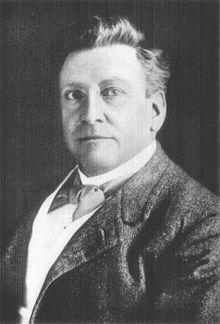
William Hesketh Lever (1851-1925)
William H Lever, founder of the soap firm Lever Brothers, later the giant multi-national Unilever, spent a short period in Parliament as an MP, before moving on to the Upper House as Lord Leverhulme.
Though a firm Liberal and strong supporter of Gladstone, Lever was wary of a parliamentary career interfering with his growing business interests. However, as a well-known and respected business figure in Merseyside, he had obvious attractions to the local Liberals, who were always keen to put him forward as a candidate. Conveniently for Lever, most of his campaigns were for nominally unwinnable seats, so he could discharge his political obligations by campaigning vigorously without too much risk of actually topping the poll.
Three times he was prevailed upon, despite his clear reluctance, to contest Birkenhead. Though he was assured that he had “not a dog’s chance” of winning in the July 1892 general election, his efforts did halve the Tory majority. When, two years later, the seat became vacant, he tried to buy off the local party by promising to pay the election expenses of their chosen candidate, but would expect them to foot the whole bill if they selected him. They called his bluff, and this time he almost snatched an unlikely win, falling short by only 106 votes (0.8%) at the 17 October 1894 poll, after several recounts. And again at the 1895 general election, the unwilling candidate performed well.
With no contest at Birkenhead at the 1900 general election because the sitting Tory, serving in the Boer War, was unopposed, Lever was corralled by his local party in the Wirral constituency, with the same predictable outcome.
His ‘luck’ turned at the 1906 general election, when the Wirral’s prospective Liberal candidate stood down at the last minute, and Lever, chair of the local Liberal Association, was again drafted in. Amidst a Liberal landslide nationally, he won the seat, with 8,835 votes to the incumbent Tory’s 7,132.
Once in Parliament, his social reformism encouraged an early focus on two related issues – old age pensions and payment of MPs.
His maiden speech, made soon after his arrival, during the King’s Speech debate on 20 February 1906, argued the need for state provision of pensions. The following year, he introduced a Private Member’s Bill on the issue, which was overwhelmingly carried at Second Reading on 10 May, 232-19, but which did not progress further because of lack of time.
Lever’s second speech, on 7 March 1906, was on MPs’ pay. With the current controversy, it is worth recalling the very different situation a century ago:
“… the time has now arrived when it is urgently required, in order to give to every constituency an equal, free, and unhampered selection of parliamentary representatives …[T]he payment of Members was required to maintain the dignity and prestige of the House, and .. it would enormously raise the efficiency of the House.”
In both issues, Lever was running with the reforming tide of his Government, with a form of old age pension established in 1908, and salaries for MPs agreed three years later.
Lever had time to interest himself in improving the Palace of Westminster. A suggestion by another MP, in a July 1908 PQ, for the addition of a verandah to the riverside Terrace, was rebuffed by the relevant Minister, Lewis Harcourt, claiming that it would deface the existing architecture. Lever wrote to Harcourt, proposing a second terrace be built on columns above the existing one: “I should not venture to make the suggestion, if I believed that it would do other than improve the architectural effect as seen from Westminster Bridge.” He even offered to pay for the drawing up of plans, but, with no positive response from Harcourt, this remarkable proposal lapsed.
Typically, Lever was soon telling his local party that he planned to step down from Parliament. However, the Government whips assured him that they would not call on his attendance much in 1907, to allow him to focus on his business interests. Lever agreed to this generous proposal, but maintained that he would not defend the seat at the next election.
Nevertheless, he did agree to stand for the hopeless seat of Ormskirk at the January 1910 election, where, for the final time in an extraordinary electoral career, he cut the Tory majority.
So ended his reluctant Commons career, though he did speak a few times in the Lords. As he told his supporters at his Ormskirk adoption meeting on 20 November 1909, he ‘had always found it difficult, owing to business claims, to find time for Parliament, and he had always pointed this out, but it had never made any difference to him as a candidate in his efforts to win a seat.’