
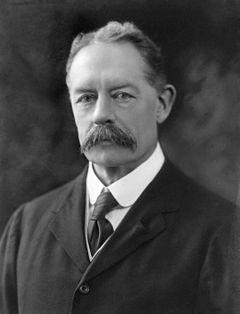
William Henry Grenfell (1855-1945)
William Henry Grenfell was a famously multi-talented athlete and sports administrator in the late 19th and early 20th century. He is remembered as president of the 1908 London Olympics. He also had four separate stints as an MP over a quarter of a century.
He came from a political family, being the son of Charles William Grenfell, a Liberal MP, and great grandson of Pascoe Grenfell, a Whig MP in the early 19th century. His maternal grandfather, William Saunders Seabright Lascelles, was also an MP for most of the period between 1820 and 1851.
Grenfell began his parliamentary career early, shortly after graduating from Balliol College, Oxford in 1879, being invited to stand as a Liberal for Salisbury. He topped the poll in April 1880, and he and his fellow successful Liberal survived a legal challenge to the result.
However this rapid rise stalled in November 1882, when his appointment to the political office of Groom in Waiting to the Queen necessitated a by-election. Unfortunately, he was defeated by his Tory opponent, Kennard (whom he had beaten in 1880) after a brief campaign.
He did not stand again until the 1885 general election, in a straight fight with Kennard for the now single-seat constituency of Salisbury. In November, he was returned in a very tight race, with just under 51% of the vote.
Again his tenure was brief, despite being made private secretary to the Chancellor of the Exchequer, as he lost the seat in the July 1886 general election caused by Government splits over Irish Home Rule. If Grenfell had rejected the Home Rule Bill, he could have been unopposed by the Tories in Salisbury.
Grenfell tried unsuccessfully to return to the House at the April 1990 Windsor by-election. Despite support from Gladstone, and a lively campaign (where Eton schoolboys tried to tear down pro-Grenfell banners), he was well beaten in this Tory stronghold.
He was more successful in July 1892 when he rode the rising Liberal tide to capture Hereford from the Tories. But, again, he was not destined to enjoy a long stint in the House, as he opposed Gladstone’s minority government on its new Irish Home Rule Bill, and on currency reform. Grenfell advocated bimetallism (linking currency value both to gold and silver rather than gold alone) and thought the gold standard policy harmed the economy.
It was wholly appropriate that the future Lord Desborough resigned from the Commons in August 1893 by being appointed, in the time honoured manner, as Steward and Bailiff of the Chiltern Hundreds of Stoke, Desborough and Burnham.
His next electoral foray was as a Conservative in the 1900 general election, when he won Wycombe, after being selected at the last moment when the Tory incumbent succeeded to an earldom. His shift in party allegiance had become evident when he assisted the Tory candidate at an Oxford by-election in April 1895.
This time, Grenfell served virtually a whole Parliament, only departing when elevated to the Lords in the resignation honours list in December 1905. During this period, the seeds of his connection with the 1908 London Olympics were sown. The British Olympic Association was formed in May 1905, and at a meeting in the Commons that month, its constitution was agreed and a council formed with Grenfell as its chairman.
Based at Taplow Court, Buckinghamshire, he was involved with ‘The Souls’, an aristocratic social set formed in the late 1880s whose most noted member was the future Tory PM, Arthur Balfour. Under William’s wife Ethel (‘Ettie’), Taplow remained fashionable for many years, hosting the political elite and even royalty.
On 2 December 1920, the Times announced the sudden death of Lord Desborough, describing how he collapsed and died almost immediately during after-dinner speeches at a Birmingham hotel. It published an effusive obituary, lauding his many sporting feats, and listing more briefly his political career.
This came as a great shock to Desborough, who would live for another 25 years. The following day, the contrite newspaper had to publish an apology for confusing him with Lord Bessborough.
Grenfell’s enduring fame lies with his sporting prowess. As a politician, he did not quite reach gold (or even silver) medal standard.