
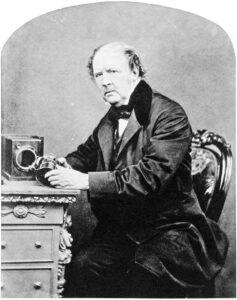
William Henry Fox Talbot (1800-1877)
William Henry Fox Talbot was not just one of the key inventors of photography, but was a true polymath of the 19th century. In his early thirties, he was also a Member of Parliament for the Wiltshire borough of Chippenham
He was unsuccessful in his first campaign in the April 1831 election, called by the Whigs following defeat of the first Great Reform Bill. Talbot was a known parliamentary reformer, but Chippenham was a two-member constituency with a tiny electorate of freemen controlled by a local Tory landowner, Joseph Neeld, who was standing for re-election alongside his brother-in-law, Henry Baldero. Talbot’s 39 votes at the 30 April poll were well short of Neeld’s 96 and Baldero’s 60.
By the time of the next election, the Reform Bill had passed. With an enlarged franchise, and Baldero not standing again, Talbot had a fairly clear run at the second Chippenham seat. And so it proved, with his 133 votes at the 10 December 1832 poll barely shy of Neeld’s 139.
When he arrived at the start of the new Parliament on 5 February 1833, he was quite taken with his new environment. Two days after his arrival, he wrote to his mother that “the Irish Members have such fun in them.” But, by 20 February, he was becoming exasperated by their filibustering tactics, prophesying “tiresome because useless resistance” to the forthcoming Irish Church Bill: “The Library of the House of C[ommons] I intend in future to make my place of refuge from Hibernian oratory.”
Though not active in debates, he was a diligent representative. At least, he was when he attended. Married just 10 days after his election, he went on a six-month honeymoon in Europe in late 1834, which, not surprisingly, provoked some criticism. However, with Parliament in recess much of that time, he thought that “Ministers seem to have had it all their own way at last, and not to have wanted any more votes. So I think I was much better in the mountain air last month than I could have been in the H. of Commons”.
He often criticised Parliament’s ways, such as long and late sittings, as the “severest part of parliamentary labour … such an absurd and injurious custom.” He hoped the October 1834 fire, which had destroyed the old Palace of Westminster, would force Parliament to modernise its practices: “I thought the old House so ill adapted to its purpose, that I cannot help approving the notion of our having a new one, more especially now that we have no choice on the subject.” He also railed against the size of the House: “It is like planting 658 young trees where we should put 200, they press upon & stifle each other, & no tree comes to perfection.”
On 12 March 1834, Talbot presented a petition on the impact of the poor laws on his village of Lacock, near Chippenham. He also supported railway expansion into the West Country – regularly corresponding with the great engineer, Brunel – although, after his departure from Parliament, he betrayed a touch of ‘nimbyism’ when he petitioned Parliament against a proposed branch line which would have run close to his property in Lacock.
In December 1834, near the end of his Commons career, he wrote an open letter to his constituents, defending his record: “I have not ceased to attend to your interests in parliament to the best of my judgement .. With regard to my votes on public measures, I have kept faith with you in all respects … The numerous votes in which I participated during these two sessions of Parliament were conscientiously given by me to the best of my judgement.”
Talbot did not relish the campaigning aspects of politics, nor its potential expense. He wrote to his friend, Charles Feilding on 26 Nov 1832 that “I hope no Conservative with a long purse will take the field at the last moment – I mean to spend next to nothing, so they may elect me on that principle if they please, or not at all.” After leaving Parliament, he informed a correspondent on 27 January 1835 that he was not currently an MP “having retired to avoid the expense of a contested election”.
Neither was he comfortable with the volatile parliamentary politics of the period. He confessed, in May 1834, when the position of the PM, Lord Grey, was extremely shaky, that “I don’t comprehend anything about it, nor who can act with who, and why the remainder cannot – it is all an enigma to me.”
His scientific colleagues, while happy to press him to promote their interests at Westminster, were dismissive of the world of politics. In March 1833, one anxiously hoped that Talbot would “not forget your Scientific pursuits. [which] should not be neglected for the infinitely less valuable occupations of a political life.” His mother wrote in similar vein in December 1835, after Talbot had left Parliament: “I am extremely pleased at your present occupation & think it will result in more happiness & fame than ungrateful politics, which after Men have strutted their hour, leave not a wrack behind.”
Indeed.