
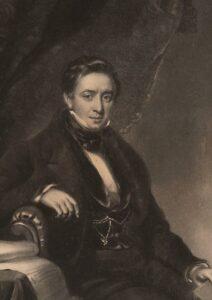
Thomas Noon Talfourd (1795-1854)
Thomas Noon Talfourd was an influential early Victorian playwright, as well as a noted barrister and judge. Charles Dickens dedicated The Pickwick Papers to him in 1837, and based the character of Tommy Traddles on him in David Copperfield. And over two stints totalling 8 years, Talfourd was a Whig/Liberal MP for Reading.
Talfourd’s first political action was a speech in his home town of Reading in 1819 supporting rights of assembly, following the notorious Peterloo Massacre two months earlier. He became a barrister in 1821, and also worked as a journalist and literary critic.
These interests sometimes merged, as when, in 1841, he defended the late poet, Shelley’s publisher, who was charged with blasphemous libel over one of Shelley’s poems. So eloquent was Talfourd’s legal argument that, although a nominal guilty verdict was returned, no sentence was imposed and the case boosted Shelley’s reputation and discredited the draconian libel laws.
He topped the poll at Reading in the 1835 general election, and his maiden speech, on 1 April, was on the hugely controversial issue of the established Church of Ireland, a debate which, a week later, would lead to the resignation of Peel’s short-lived minority Tory government.
His main Commons focus was on two important legal reforms. The first aimed at granting custody of children to mothers separated or divorced from the fathers. Talfourd, having been counsel in two such cases, was aware of the injustice of the existing law. He was also influenced by Caroline Norton, whose own marital problems had resulted in a sensational court case by her husband in 1836 against the Prime Minister, Melbourne. Norton’s campaign on the plight of separated mothers denied access to their children assisted Talfourd in introducing a Bill in 1837. Eventually, two years and several Bills later, the Custody of Infants Act 1839 became law.
The other reform was of copyright law, which resulted in a more protracted legislative battle. Supported by luminaries such as Wordsworth, Carlyle and Southey, he introduced in 1837 a Bill to extend the period of copyright to the benefit of authors and their heirs, amid a wider scheme of copyright reform. Despite a glittering speech in its support, he was unsuccessful in this and later Bills because of a wide coalition opposed to reform, including Radicals and others, like TB Macaulay, who denounced copyright as censorship and a tax on readers.
Talfourd despaired of success, as he wrote in his diary: “For five years I have worked the Copyright Bill in the House of Commons – to see it thrown out in one night by Macaulay.” By the time a more limited reform was eventually passed in 1842, Talfourd was not an MP, though he received due recognition as its inspiration.
Elections at Reading were rarely easy for Talfourd, as the non-Tory vote was often split. The 1837 general election was a very tight three-cornered fight for the two seats. Talfourd topped the poll, just 11 votes ahead of his fellow Liberal, and only 20 ahead of the Tory. The result was challenged on petition, but fortunately for Talfourd, his election was not questioned.
At the 1841 election, local party relations had so broken down – with his friend Dickens even being approached as an alternative Liberal candidate – that Talfourd chose not to stand. This enabled the Reading Conservatives to capture both seats.
Talfourd was persuaded to return to fight Reading in 1847. He told an election meeting he had been offered other constituencies “for which I could have been returned with much less trouble and anxiety, but my reply had always been ‘I will be member for Reading or nothing at all.’” In a close contest, the two Liberals defeated the two incumbent Tories.
His radicalism mellowed with age, and one of his last Commons speeches, in 1848, strongly opposed Joseph Hume’s motion for political and electoral reform. His elevation a year later, as a judge of the Court of Common Pleas, meant the end of his political career.
Talfourd died suddenly while addressing a Stafford jury in 1854. Dickens wrote an effusive obituary, describing him as “widely appreciated, honored, and beloved.” In Parliament, however, his oratory in the House did not match his literary efforts.