
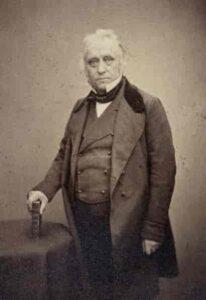
Thomas Babington Macaulay (1880-1859)
The great Victorian historian, Thomas Babington Macaulay, sat in Parliament for several different seats over more than a quarter of a century.
He gained his first footholds in public life through patronage, first by being made a Commissioner in Bankruptcy by the then Tory Lord Chancellor, Lord Lyndhurst, in 1828, and then in 1830 when he was offered a parliamentary seat at Calne, a borough controlled by the Whig grandee Lord Lansdowne. He was returned at a by-election in February 1830, and held the seat at the subsequent general election several months later. Following the Reform Act, he switched to a newly created seat at Leeds.
Though a Whig, he was not a sectarian politician, feeling that literature was more enduring than politics. Holding public office provided opportunities for securing the financial independence to allow him to focus on his writing, most famously his History of England.
This influenced his career decisions, as when in 1834 he accepted a lucrative post on the new Indian Supreme Council, giving up his seat and his junior ministerial post. Despite claiming to be “not fond of money, or anxious about it,” he felt increasingly keenly how necessary an adequate fortune was “to a man who either desires to be great or useful.”
Several times he turned down approaches to return to ministerial office. For example, in November 1838, he refused a minor office, preferring either a Cabinet post – “office of the highest rank”, as he called it – or life as a backbencher, rather than repeating the “bitterness of that slavery” of junior office.
Even political setbacks, such as losing office in 1841 or his seat in Edinburgh in 1847, did not seem to him to be matters of great regret. On the former occasion, he wrote: “Now I am free. I am independent. I am in Parliament, as honourably seated as man can be. … I have leisure for literature; yet I am not reduced to the necessity of writing for money. … I am sincerely and thoroughly contented.”
He enjoyed a spirited rivalry with the leading Tory, Robert Peel. Peel praised the style of the first of Macaulay’s impressive series of speeches on the Whig Government’s Reform Bills in 1831-2, saying that “portions of that speech were as beautiful as anything I ever heard or read. It reminded me of the old times.” Macaulay often taunted Peel for policy U-turns, such as on the Corn Laws in the mid-1840s. The most famous of his parliamentary attacks was when supporting Peel’s hugely controversial bill to fund the Catholic seminary at Maynooth College in May 1845.
Perhaps it was his less than full-hearted political ambition that enabled him to take stances opposed to his party. When a junior minister for India in 1833, his loyalty to his father’s long-held anti-slavery stance led him to speak and vote against his own Government’s abolition Bill because of its generous concessions to slave-owners. Macaulay offered twice to resign, but was refused by a Government already struggling with the Lords over other controversial legislation.
Whether through naivety or pomposity, he could make embarrassing political gaffes. Following a return to Parliament in 1839, he was quickly given a Cabinet post. When writing to inform his Edinburgh constituents of his new post, he foolishly addressed it from Windsor Castle. His enemies had a field day, mocking him for such haughty presumption. In late 1845, following the Whigs’ failure to construct a Government when Peel was in crisis over the Corn Laws, he blamed a senior colleague, Lord Grey, in a letter, which was made public by its recipient.
His attitude to the Chartists’ political reform demands showed that he was no radical. He spoke against their petition on 3 May 1842: “I believe that universal suffrage would be fatal to all purposes for which government exists, and for which aristocracies and all other things exist, and that it is utterly incompatible with the very existence of civilisation.”
Following his electoral return for Edinburgh in 1852, five years after his humiliating and unexpected defeat there, his final parliamentary years were relatively quiet. His last speech in the Chamber came in 1853, though he did not finally retire as an MP until early 1856.