
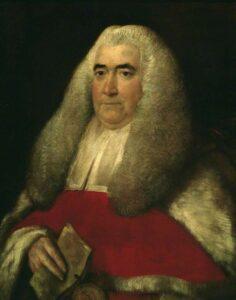
William Blackstone (1723-1780)
The fame of the great 18th century jurist, Sir William Blackstone, rests with his highly influential multi-volume Commentaries on the Laws of England, which was one of the most important academic works on English law. He also served for nearly a decade as a Tory MP.
From 1738, first as a student and then as a Fellow of All Souls College, Blackstone grew up in the largely Tory enclave of Oxford University at a time of Whig hegemony. He took part, as a Tory, in the various elections within the University for the Chancellorship, which were surrogate party political campaigns, and he successfully ran the campaign of the Tory candidate at a 1751 University parliamentary by-election.
The battle for the two Oxfordshire county seats at the 1754 general election was a notorious struggle, with two separate pairs of candidates being returned. Eventually, a year later, the Whig-controlled Commons awarded the seats to the Whigs rather than to the Tories who were ahead in the original count. Blackstone played an important, if largely unseen, part in the campaign, and in the legal arguments on the election petition in Parliament.
Blackstone’s own chance to enter Parliament came when the accession of George III in 1760 undermined the long Whig ascendancy, throwing party politics into flux. He secured the patronage of the future Earl of Shelburne, a leading Whig with good connections to Tory leaders such as the Earl of Bute. As a student, Shelburne had attended Blackstone’s lectures at Oxford.
Shelburne suggested Blackstone for the Wiltshire seat of Hindon at the 1761 general election. Blackstone initially rejected these overtures, on the grounds that he was about to be married, and also because he did not meet the statutory property qualification for being an MP.
He was gradually persuaded otherwise. The marriage impediment became merely “little private domestic inconveniences … I am willing to waive,” and the property qualification was resolved when sufficient funds were forthcoming from Bute. With this backing, he was returned unopposed at the end of March for one of the Hindon seats.
The depth of Blackstone’s parliamentary commitment was revealed when he heard a report that he had somehow actually lost the election, and wrote to Shelburne that he “little expected or sought for a seat in Parliament.” Luckily for him, he learned the truth the following day.
When the next general election approached in 1768, he knew he did not have sufficient support to fight Hindon. His professional legal work came to his rescue. He had been helping the Earl of Abingdon successfully gain control of the borough of Westbury, through various arcane property transactions. Blackstone was rewarded for his efforts by being returned unopposed for one of its seats in March.
His Oxford law lectures in the 1750s were published between 1765 and 1769 as the Commentaries, while he was an MP. His legal views were now open to public and parliamentary scrutiny. He had already toned down some passages from the original lectures, to avoid political controversy, but still found he had to make further amendments when sections on slavery and on religious non-conformity were questioned.
This problem was most acute over the Commons’ many attempts at unseating the maverick radical, John Wilkes. Blackstone seemed at one point to be disagreeing in the House with what he himself had written about Members’ disqualification. This provoked much ridicule, and he was forced to resort to equivocation in his arguments and his votes on the matter, and even to pleading for sympathy because he was sick.
This humiliation was the last straw for Blackstone’s unhappy parliamentary tenure. He had not been the asset the Tories had initially hoped for; he was a poor orator in the House – his delivery was likened to “reading a lecture in college” – and he had little political guile or instinct. After rejecting the offer of the new Tory Prime Minister, Lord North, to make him Solicitor General, he accepted a judgeship in February 1770, thereby giving up his membership of the House.
Probably Blackstone’s main motive for embarking on a political career at all had been to increase his chances of appointment to the judiciary. If so, he had, eventually, succeeded.