
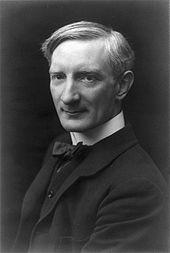
Sir William Beveridge (1879-1963)
Sir William Beveridge served at the highest levels of the civil service and academia, and is remembered for his ground-breaking official reports on social policy in the 1940s. Near the end of the War he squeezed in nine months as a Liberal MP.
In 1941 he was asked to chair two obscure government committees. One, on ‘social insurance and allied services’, became the ‘Beveridge Plan’, the blueprint for the welfare state. He gained a strong public profile throughout 1942, and by the time his report was published in December, both he and it were, to the Government’s embarrassment, headline news.
This brought invitations to stand for Parliament. With the Coalition Government hesitant over his Plan, an influential political base appealed to him. An electoral truce meant that the major parties agreed not to stand against candidates of the previous MP’s party in by-elections, but he was not keen to stand as an Independent, as that would imply opposition to the wartime Government. A University seat, where Independents were common, was his preferred option,
He was wooed by Labour leaders, including Herbert Morrison, but trade union suspicions over their role and influence if his Plan was implemented prevented a deal.
After the Report’s publication, he was approached by the Liberals to stand for Dunfermline, but he hesitated too long, still hoping to be given further government work, and he also wished to operate politically “with sufficient independence of position.” In January 1943 he also missed the opportunity to contest a vacancy at Watford, for similar reasons.
The Liberals continued to woo him, stressing their support for his policies, and their ‘branding’ as a non-socialist left-wing party. Then a vacancy unexpectedly appeared at Berwick-upon-Tweed in late July 1944, when the Liberal MP, George Grey, was killed in action. Grey had visited Beveridge at Oxford a few weeks earlier to express his admiration of him and his policies. The electoral truce meant that nomination as a Liberal virtually guaranteed election, and Beveridge decided he would accept if he were asked to stand.
His adoption in September annoyed University College, Oxford, where many feared that his election would worsen what they already regarded as his neglect of his duties as Master of the College.
Beveridge easily beat his one Independent opponent at the 17 October poll, 8,792-1,269. His wife, Janet apparently declared at an eve-of-poll meeting: ”You have your chance of Willum. Take it. When I had my chance of Willum I never hesitated for a moment.”
Aged 65, Beveridge took his seat two days later, and was personally welcomed by Churchill. Fortunately, this was just a few weeks after the publication of two major White Papers based on his Report, and so he could participate in the debates on them.
He made his maiden speech on 3 November during the social insurance debate. It contained a rather laboured section about the Plan being his baby, e.g:
… it is nearly two years ago since I laid on the doorstep of His Majesty’s Government in Whitehall, a Report on Social Insurance—a large and rather noisy baby. But most kindly the Government took that baby in, and cared for it, and I lost sight of it.
He also spoke in the debate five days later on the White Paper on industrial injury insurance, where he returned to the ‘baby’ analogy of his original Report, describing it now as a ‘twin’.
Thereafter, he made several speeches, not just on social policy. In January 1945 he supported the Single Transferable Vote for local elections, and in two later speeches, he criticised the Allies’ plans for the structure of the post-war United Nations organisation. He also dealt with constituents’ concerns, including even the repeal of the Witchcraft Acts!
With a general election imminent, Beveridge, despite a lack of electioneering experience, chaired the Liberal’s Campaign Committee, making more than 150 speeches in three months. One commentator of wartime politics said the Liberals regarded Beveridge as “their political lifebelt”. But to no avail, as the party was marginalised, with both Beveridge and his leader, Sir Archibald Sinclair, losing their seats.
Beveridge’s political naivety and hubris had been exposed by his clear defeat at Berwick in July 1945. As he admitted, “I never doubted my power of holding the seat indefinitely.” He had even bought, and moved into, a house there that spring. He had misread the strength of Tory support and how suspicious local Liberals were of his collectivist ideas. His stepson shrewdly wrote that “Will’s inexperience of the political scene led him to confuse the acclaim, which was still showered on him, with votes at the poll.”
That marked the end of Beveridge’s Commons career. He refused an offer in 1946 of nomination as an Independent in a University by-election. He entered the House of Lords in June that year, where he was an active participant.