
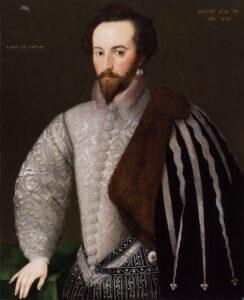
Sir Walter Raleigh (1554-1618)
Sir Walter Raleigh (or Ralegh – either is acceptable) was a contemporary of that other great Elizabethan seaman, explorer and sometime parliamentarian, Sir Francis Drake.
Several members of Raleigh’s family were MPs. His father, also Walter, sat for Wareham in 1558; his eldest brother, Carew, was a fellow Member, sitting in six parliaments during the 1558-1621 period, and one of his sons, also Carew, was in the Rump Parliament when it sat on and off during the Cromwellian interregnum.
As was common in that period, Raleigh’s personal, social and political fortunes waxed and waned with royal favour and establishment patronage. He sat in five of Elizabeth’s parliaments between 1584 and 1601. In four of those he was returned as a ‘knight of the shire’ for West Country counties, where he held various offices and estates – Devon in 1584 and 1586, Dorset in 1597 and Cornwall in 1601.
He didn’t sit in the 1588-89 Parliament, because of military business, and in 1593 he was not a favourite at court, partly because of his affair with one of the Queen’s maids of honour (whom he secretly married in late 1591 when she became pregnant). Under such a cloud, a county seat was more difficult to secure for the 1593 Parliament, but Raleigh managed to be returned for the borough of Mitchell, in Cornwall, a far less prestigious seat. He also seemed to be widely involved in borough patronage himself, with around 60 Cornish MPs under his influence, either directly or through family or friends.
Parliaments were generally summoned in the latter part of the Queen’s reign to raise money to prepare for, and conduct, wars with Spain. From 1593 onwards, Raleigh broke his earlier parliamentary silence, especially to defend unpopular royal requests for ‘subsidy’. This support even included, as in March 1593, successfully suggesting procedural manoeuvres to overcome impasses between the differing views of the two Houses.
Raleigh’s later speeches reveal liberal tendencies, generally supporting the rights of ordinary people against those of the rich and powerful, and opposing what he regarded as unnecessary and harmful regulation, particularly in matters of trade and religion.
His religious tolerance was evident in 1593 when he opposed the penalty of transportation for a nonconformist group called the Brownists. He deployed a mixture of high principle – the innocent could be punished as well as the guilty, and people’s intentions were to be decided by juries – and practicality, querying the potential costs of transportation and the care of dependants left in England, when up to 20,000 Brownists may have been involved. On 12 December 1601, he opposed a Bill to make church-going compulsory, arguing against the practicality of its enforcement in each parish in the realm.
A good example of Raleigh’s economic liberalism arose on the continuance of the Tillage Act in 1601, by which the Government tried to force farmers to grow hemp (for use in ships) and corn. He ended a forceful speech with a populist cry that “I think the best course is to set it at liberty, and leave every man free, which is the desire of a true English man.”
He opposed the imposition of disproportionate tax burdens on the poor through what amounted to ‘equal taxation’ proposals from the Secretary of State, Robert Cecil. They were supported by Sir Francis Bacon, in typical florid language, complete with Latin quotes. Both these grandees claimed that each person should be proud and happy to pay their equal share, even if, according to Cecil, it meant the poor selling their pots and pans. Raleigh pounced, throwing these sentiments back at them, calling it neither pleasant nor equal “when a poor man pays as much as a rich.” As for sacrificing pots and pans:
“I like not that the Spaniards our Enemies should know of our selling our Pots and Pans to pay Subsidies; well may you call it Policy, as an Honourable Person alledged, but I am sure it argues Poverty in the State…. ”
However, Raleigh was not averse to defending his own personal interests in Parliament, as he did in his first session in 1584, introducing a Bill to confirm his royal patent for the founding of what became the Virginia colony. This Bill was then committed to a Committee largely consisting of his supporters, including Drake, and passed by the House, though with some restrictive amendments.
Even more starkly in contradiction of his liberalism was Raleigh’s holding of various trading monopolies, granted by the Queen to her favourites. Not surprisingly, monopolies were disliked by the general public, and by MPs. Raleigh’s unrepentant defence of his monopolies was courageous but unpopular. One difficult occasion was on 20 November 1601 when he had to defend his tin monopoly, a matter of some importance in Cornwall, which he represented, and where he was Warden of the Stannaries. According to the Commons Journal and other accounts, this “sharp speech” was met with “a great silence”, and the next speaker sarcastically mused that “every man hath not like sence or judgment, neither is every mans memory alike.”
His fortunes fell with the Stuart succession in 1603, and he spent most of the rest of his life as a prisoner in the Tower of London, finally being executed on 29 October 1618, in Old Palace Yard, Westminster – a final, if gruesome, parliamentary connection.