
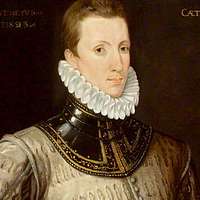
Sir Philip Sidney (1554-1586)
A true English Renaissance man, Sir Philip Sidney crammed an active public and private life, at home and abroad, into a very short period in the late 16th century. Most noted for his various literary works, especially his poetry, he also found time for two brief spells in Elizabeth’s parliaments.
He navigated through a turbulent and dangerous time for England, partly due to his illustrious family connections, with links to many in the nobility and at Court. Perhaps the most influential example was his marriage to Frances, daughter of Sir Francis Walsingham, one of Elizabeth’s most senior ministers.
His father, Sir Henry, and a brother, Robert, were also Members of Parliament. Henry served in five parliaments in the mid-16th century, representing Brackley and then Kent, and Robert later sat twice for Glamorganshire and once for Kent. Henry rose as a courtier to Edward VI, and later served both Mary and Elizabeth. He was responsible for Philip’s initial entry into Parliament in 1581, for the final session of the intermittent and much-prorogued Parliament first elected in 1572.
As the delightfully-titled Lord President of the Council in the Marches of Wales, Henry used his influence in two seats, Ludlow and Shrewsbury, which had vacancies through the deaths of sitting Members. Philip was duly returned unopposed for both in January 1581, but chose Shrewsbury, perhaps because he had for several years gone to Shrewsbury School.
Philip’s presence in this brief session of only two months was famously described by one historian as being “an ornament rather than a power in the House.” Nevertheless he was a member of two committees directly concerned with the great questions of the period – domestic religious turbulence and the risk of foreign invasion – though little is known about what, if any, active part he took in these and other deliberations.
Following a rousing, blood-curdling ‘state of the nation’ speech on 25 January 1581 by Sir Walter Mildmay, one of Elizabeth’s most senior ministers, detailing the many domestic and foreign threats to the Crown and country, Sidney was among the Members appointed to the Committee established to consider the subsidy required for the defence of the state.
On 1 February he was appointed to a large committee scrutinising a Bill “against slanderous Words and Rumours, and other seditious Practices, against the Queen’s Majesty,” a Bill which had a stormy and controversial passage through Parliament.
Sidney was returned to the next Parliament, which operated for five months from November 1584. This time he represented his native county of Kent, where his father, Henry, had sat for the past three Parliaments, and which his brother, Robert, would represent in 1597. By 1584, the various internal and external dangers threatening England were even more acute, and Philip was again appointed to a committee considering the subsidy, and also to one to negotiate with the House of Lords over the two Houses’ differences in the terms of draconian legislation against the Jesuits.
Again, virtually nothing is known of Philip’s active participation in these proceedings, though external evidence suggests that he was not as vehement a supporter of the harsh suppressive legislation against Catholics as many Members, and also that he sympathised with aspects of the growing Puritan tendency in the Commons, which was viewed with suspicion by the Upper House.
As well as these momentous issues, the 1584 Parliament managed to transact much more routine business, and, between December and March, Philip is recorded as serving on committees dealing with matters such as the preservation of Sussex timber; the preservation of woods in Kent; the maintenance of Rochester Bridge; confirmation of the letters patent of Walter Raleigh, and the privileges of the London curriers (those who prepared and dressed leather).
One other brief and indirect mention of Sidney in that Parliament was the issue on 15 March 1585 of a warrant for a writ of privilege for the release from a London debtors’ prison of his servant, a John Pepler.
Sidney was seriously wounded in battle with Spanish forces in the Netherlands on 22 September 1586, and died on 17 October, at the very time when the next Parliament was being elected and convened.
To what extent his untimely death just short of his thirty-second birthday prevented the realisation of what one biographer described as his ‘immense political potential’ is a matter for conjecture, but his truncated public life suggests that he might well have contributed to the dramatic political and parliamentary stages of the later Elizabethan era. Though a matter of academic dispute, some have also claimed that the political ideas embedded in his literary works were influential for decades thereafter.