
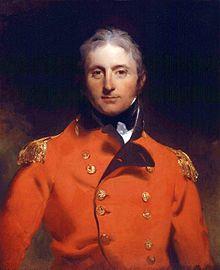
Sir John Moore (1761-1809)
General Sir John Moore was one of Britain’s most celebrated military officers, famous for his command of the army during an ill-fated campaign in the Peninsular War against Napoleon, and his heroic death in battle at Corunna, Northern Spain, two hundred years ago, on 16 January 1809. For six years in the late 18th century Moore, who was born in Glasgow, was also an MP for a Scottish seat.
After serving in North America during the American War of Independence, Moore was offered a parliamentary seat by Douglas, the 8th Duke of Hamilton (a notable patient of his father, Dr John Moore). Hamilton was, with other Scottish Dukes, the patron of Linlithgow Burghs, a Scottish seat made up of the four burghs of Linlithgow, Selkirk, Lanark and Peebles, and, for the 1784 general election, he had the choice of candidate.
Despite poor spring weather, the young Captain Moore apparently campaigned extensively, and it is recorded that he spoke at an election meeting in the galleried ballroom of Selkirk’s main inn. In the 26 April poll, he was returned unopposed, a not uncommon practice in those days.
Though his father was a Whig (and he would later be described as a ‘Whig general’), Moore was, in common with many junior officers of the period, inclined towards the Tory Government, and especially its new Prime Minister, the Younger William Pitt. However, when Hamilton offered him the seat, Moore made him agree that he could operate independently of any party and remain free to follow his own judgement on every matter, the assumption being that he would otherwise have refused the Duke’s offer.
Moore took his seat on 18 May 1784, following Pitt’s clear election victory. Generally he supported the Administration, even in its controversial proposals such as parliamentary reform, Ireland and military policy, believing that the Premier genuinely had the country’s interests at heart. He remarked ironically: “I suppose I pass for the greatest Tory in the family”.
Though he seems never to have made a speech in the Commons, he attended assiduously when the House was sitting. His father, Dr Moore, was a well-known member of London society, and the friend of many notables of the period. One such friend, Edmund Burke, though politically on the opposite side from John Moore, complimented him to Dr Moore on his political ability in the House.
Moore’s life during this period by no means revolved solely around his parliamentary duties. When in London, he participated in the social life of the establishment, even meeting the King’s son, the Duke of York. As his brother, James, wrote in a biography of Moore, he “being in the heyday of youth lived gaily and in good company.”
Even during his parliamentary years, Moore hankered after a renewed military career. In November 1785 he rejoined the active list with the 100th Foot, and bought himself a major’s commission in the 102nd Foot, though the latter regiment was very shortly thereafter disbanded. Despite this setback, a further and more secure opportunity arose in early 1788 when he joined the 60th Foot at Chatham, training men destined for duty in the West Indies. In October 1788, he rejoined the 51st Foot, where he had begun his military career back in 1776. It is recorded by one biographer that he carried a case of pistols which were engraved ‘Captain John Moore’ with ‘M.P.’ “palpably a later addition”.
Moore did not seek re-election in the 1790 general election. However, there were one or two occasions when, with apparent lulls in the ongoing French wars, he seems to have considered a temporary return to parliamentary politics to support Pitt against Charles James Fox. For example, in a letter from Bastia, Corsica, to his brother, James, on 10 August 1795 he wrote:
“I have written to the Duke of Hamilton, and I make no doubt but, in case of a dissolution, he will bring me into Parliament, if he can. …. If my presence is at all necessary, I have told him I can get leave for a short time.”
Nothing came of these approaches, and so 1790 marked the end of Moore’s political career. Not by any means a political partisan – his brother’s biography notes that “the moderation of Moore’s character prevented his becoming a violent party-man” – he was not suited to parliamentary politics in a period noted for its factionalism. It is as a soldier rather than a parliamentarian that Moore is remembered by posterity.
Nine days after his death, on 25 January 1809, the Secretary for War, Lord Castlereagh, moved a unanimous Address by Parliament to the King for a monument to be erected in his honour in St Paul’s Cathedral. Depicted in his uniform in his dying moments, it can be seen in the south transept. He was also immortalised in Charles Wolfe’s famous 1817 poem, The burial of Sir John Moore (“Not a drum was heard, not a funeral note …”).