
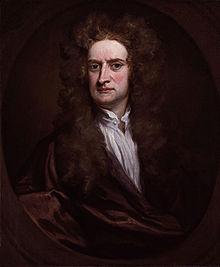
Sir Isaac Newton (1642-1727)
Sir Isaac Newton was undoubtedly one of this country’s, and the world’s, greatest scientists. As a leading academic at Cambridge University, he also represented the university twice in Parliament, participating, albeit rather silently, in momentous constitutional changes at the end of the seventeenth century.
Newton’s election for Cambridge University in January 1689 to the Convention Parliament probably owed much to his active involvement in the recent battles between it and the previous King, James VII/II, over royal attempts to impose Catholics on the university. In the two-seat election (with an electorate of around 500 doctors and masters of arts) he came second with 122 votes, three fewer than Sir Robert Sawyer but, crucially, five more than the third candidate, Edward Finch. He thus became the first ever scientist to represent a university in Parliament.
He took his seat in the Commons on 22 January, and generally supported the majority Whig line in the thirteen-month Convention Parliament which effected the revolutionary transfer of the Crown from the Stuarts to the House of Orange. He regarded his parliamentary role primarily as protecting the University’s interests during this turbulent time, and reported back regularly by letter to the Vice-Chancellor, Dr Covel. One letter, on 6 March 1689, seems to reveal Newton’s less than complete grasp of parliamentary procedure:
“A grand committee of our House has passed some votes about imposing the new oaths, which I had rather you should have from another hand. They outvoted us yesterday by about fifty votes.”
There are few details of his participation in the proceedings of this Parliament. He is recorded, for example, as a teller for the losing side in a motion for the adjournment on 22 February, and was nominated to a few committees on Bills and other matters. On 30 April, he gained leave to bring in a Bill to confirm the charters and privileges of the University. However, he appears never to have made a speech during this Parliament, and virtually every biography recounts the possibly apocryphal story that his only contribution was to ask an usher to close a window because it was causing a draught.
The Convention Parliament was dissolved on 6 February 1690, but Newton did not stand for re-election, probably because he was aware of a general swing away from his Whigs to the Tories (two Tories were returned by the University in 1690). His major public service thereafter was at the Mint, first as Warden, from 1696 – in which capacity he gave evidence to a Commons Committee in April 1697 – then as Master from 1700.
He agreed to stand for Parliament again in the second general election of 1701, largely to help keep out the Tories. He was easily elected, gaining 161 votes, just 19 short of his fellow Whig, Henry Boyle, with the Tory, Anthony Hammond, trailing in a poor third with only 64. Again, there is no record of any speech by Newton, and very little of any other participation in this short Parliament which ended prematurely following the death of King William III in March 1702.
Again, he chose not to stand for re-election, perhaps because of a resurgence towards the Tories, under the new Queen, Anne. He publicly explained his reasons in a letter to friends:
“I would have it understood that I do not refuse to serve you …but by reason of my business here I desist from soliciting, and without that, I see no reason to expect being chosen. And now I have served you in this Parliament, other gentlemen may expect their turn in the next. To solicit and miss for want of doing it sufficiently would be a reflection upon me, and it’s better to sit still.”
He was reluctantly persuaded by his Whig friends to stand again in the May 1705 election, but, despite being knighted by Anne when she visited the University in April – an event seen by the Tories as a blatant royal campaigning stunt – Newton polled badly, ending up a poor fourth in a field of four, with only 117 votes, far short of the other candidates who secured between 162 and 182 each. Part of this was probably due to his late withdrawal from the context, in a vain attempt to shore up support for his fellow Whig, Francis Godolphin (both seats were won by Tories, with Godolphin falling short of second place by 8 votes).
Though he did act as an expert adviser to a Commons committee in 1714 examining methods of determining longitude at sea, then an important practical navigation issue, 1705 was Newton’s final parliamentary battle. Despite having sufficient gravity, he was not a parliamentarian, and never stood again, which, in the words of one biographer, “was no great loss to either himself or the nation.”