
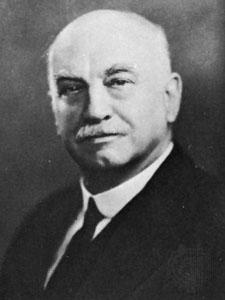
Sir Herbert Austin (1866-1941)
Sir Herbert Austin already had a long career as an engineer and car-maker, founding the Austin Motor Company in 1905 in the West Midlands, before he became an MP at the age of 52.
He was a reluctant candidate in the December 1918 election, just a month after the Armistice. This was the ‘Coupon Election’, where approved candidates were publicly endorsed by the Liberal Premier, Lloyd George, and the Tory leader, Bonar Law.
A Coalition Conservative, Austin was selected for the new seat of Birmingham King’s Norton, comprising areas where his Longbridge workers lived. Though challenged by two candidates including the rising Liberal lawyer, Norman Birkett (later a senior judge), he won easily with nearly 55% of the vote.
Other prominent capitalists entered Parliament in 1918 as Coalition Conservatives, including Douglas Vickers, from the engineering family, and the sugar refiner, Leonard Lyle. Lloyd George was said to have described these backbenchers derisively as the “Associated Chambers of Commerce.
Austin held on to his seat in the general elections of 1922 and 1923, though with much reduced majorities. Birmingham was a Conservative stronghold, and Austin was a major local employer, a fact which the Times alluded to during the 1922 campaign: “King’s Norton is not likely to forget its own interests and reject one who is truly a captain of industry.”
At the 1923 poll, his two opponents were female – a rare event in those days – including the Liberal, Elizabeth Cadbury, of the Birmingham confectionery family, a noted philanthropic welfare worker and local councillor.
However it was a different matter in the 1924 general election, when, despite the Conservative landslide over Ramsay MacDonald’s brief minority Labour Government, Austin was one of the few Tory losses. The victorious Labour candidate, by a mere 133 votes in a poll of 24,000, was a union official, Robert Dennison. This was the end of Austin’s Commons career, but not of his involvement in political debates, nor with Dennison at elections.
Just before polling day in the 1929 general election, Dennison sparked a controversy when he attacked remarks by Austin – then actively supporting the Conservative candidate – which appeared to suggest that a repeal of the protectionist McKenna Duties would affect the viability of his Longbridge factory. Dennison purported to pledge on behalf of Labour that if the plant were shut down by Austin, it would be taken over by the Government, “and Sir Herbert Austin and other like-minded people may find themselves out of a job instead of their work-people.”
Austin angrily rejected Dennison’s charges, dismissing the nationalisation threat as “such utter nonsense as to be unworthy of even a moment’s consideration”. The affair probably contributed to Dennison’s narrow defeat in King’s Norton.
Over nearly six years in the Commons, Austin never made a single speech, but is recorded as having voted in divisions, and was nominated to at least one standing committee. One of his employees recalled that, in the early 1920s, when the company was busy designing the Austin Seven, Austin had to absent himself for periods because “being an MP he had to go to Parliament and all the rest of it”.
That he was not the most diligent of parliamentarians could be seen in 1923, when the Tory Government whips published their Members’ voting records for the first 53 divisions of the session. Nine Tories did not vote at all – though some of them were ill or held official positions – and Austin was alone on the Conservative benches in voting only once.
Austin was not a traditional career parliamentarian, accepting a political role after the War because he had believed that government could and should be run on business lines. He was frank about his views on parliamentary politics in a 1929 motoring magazine interview, declaring that he had “no intention of again standing for Parliament” because senior industrialists could do more public good by concentrating on their business interests than in being MPs.
Nevertheless, he was keen not to seem to be belittling Parliament. “I do not wish to infer that I regard Parliament as a home for nonentities, or as a place from which no good thing can emanate.” Just as well, since he was given a peerage in 1936.