
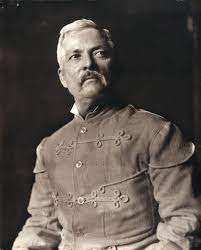
Sir Henry Morton Stanley (1841-1904)
“Dr Livingstone, I presume?” is probably one of the most famous greetings in history, allegedly said by Henry Morton Stanley when meeting David Livingstone at Ujiji, in central Africa in November 1871. Towards the end of his life, the celebrated explorer was a Liberal Unionist Member of Parliament for Lambeth North between 1895 and 1900.
Becoming a parliamentarian was a plan of his new wife, Dorothy whose father, Charles Tennant, had been a MP for St Albans briefly in the early 1830s. As she explained:
It seemed to me that one so full of energy, with such administrative power and political foresight, would find in the House of Commons an outlet for his pent-up energy .. [A]lso, at the back of my mind was the haunting fear of his returning to the Congo. I thought that, once in Parliament, he would be safely anchored.
Stanley was well aware of her motives: “I accepted because D. is so eager for me to be employed, lest I fly away again to Africa.” In June 1892, she found out that the incumbent Liberal Unionist MP for Lambeth North, Sir Charles Fraser, was not standing again in the forthcoming general election. At the nomination meeting on 20 June, Stanley was unanimously selected. With the election less than a fortnight away, according to the Times, he would “forthwith commence an energetic canvass in which, it is understood, he will be actively assisted by Mrs Stanley.”
Stanley came within 130 votes of victory, with 2,394 votes to the Liberal, Alderman Coldwells’ 2,524. Dorothy persuaded him to remain as candidate for the next election, though he flatly refused to canvass ‘house to house’ and “never will I degrade myself by asking a man for his vote.” To him “this political work involves lying, back-biting, morally-damaging your opponent in the eyes of the voters, giving and receiving wordy abuse, which reminds me of English village squabbles…”
At the 1895 general election, Stanley secured a narrow win in Lambeth North beating the Liberal, CM Trevelyan, 2,878 to 2473 (majority 405). He wasn’t impressed with the House and its facilities when he arrived as a new member in August:
The architect of the House must have been very deficient in sense of proportion, it seems to me. I think, of all the Parliament Houses I ever saw, I am obliged to confess that any of the State Houses in America would offer superior accommodation to the members. Where are the desks for the members, the comfortable, independent chairs, the conveniences for making notes, and keeping papers? In contrast to what my mind recalls of other Chambers, this House is singularly unfurnished. Money has been lavished on walls and carved galleries, but nothing has been spent on conveniences.
In a parliamentary era of Irish obstructionism, Stanley had to endure long sittings, frequent voting (“We are herded in the lobbies like so many sheep in a fold”), and the “most dreary twaddle which it has ever been my lot to hear… All my fellow-members have a remarkable gift of easy verbosity. There is a small kernel of fact in almost every sentence they deliver, but it is often indistinguishable, through the vast verbiage. The veriest trifle of commonplace fact is folded round and round with tissue after tissue of superfluity.”
He made his maiden speech, on imperial policy in Egypt, on 21 August, though he described it in his Journal merely as “a few remarks… I see those remarks are called my Maiden Speech, but as I made no preparation as I really did not suspect there would be any occasion for interposing in the debate I do not think they deserve to be called a speech.” Throughout his time in the House, his active participation focussed on Imperial issues, especially Africa, and he was irritated by the pontificating of the many MPs who had never been to the continent.
As he well knew, he was not suited to the parliamentary life, and quickly longed to escape it. He felt impotent as an MP: “I have, as a Member, less influence than the man in the street…. I can add but a grain of sand to the national edifice.”
Nor did he appreciate the representative role: “Consequent upon this Parliamentary life are the various petty businesses of the Constituency I represent; and a wearying correspondence with hundreds of people I am unacquainted with, but who insist on receiving replies.”
He did not stand again in the 1900 general election – “I am glad at the prospect of retiring, and being quit of it all.” One biographer neatly summed up Stanley the MP: “The fearless lion of African exploration was a timorous rabbit in the political jungle.”