
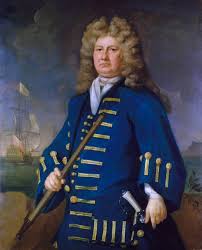
Sir Cloudesley Shovell (1650-1707)
The magnificently-named Sir Cloudesley Shovell was a post-Restoration Admiral whose naval exploits were, in their day, as famous as those of Nelson a century later. In two stints, he was also a Member of Parliament.
Shovell had over thirty years’ service at sea when he first entered Parliament for Rochester in 1695. Rochester was heavily influenced by the Navy, due to the nearby Chatham Dockyard, and the Admiralty could often effectively nominate one of its two members. Even before the expected dissolution of Parliament by William III, it was announced that the town of Rochester had agreed to elect Shovell to the next Parliament.
In October 1695 he was returned unopposed. His success may have also been assisted by a generous financial contribution to building of splendid plaster ceilings in the town’s Guildhall. At the 1698 and the first 1701 general elections he retained his seat without a contest. He continued to contribute to other building works in the town, including the Butcher’s Market (now the Corn Exchange) in 1706.
As an active naval officer, Shovell was not a regular Commons attender, being given a leave of absence as required. However, his name does appear from time to time, largely on naval matters. Though this era was one of loose political factions, often defined by their connections with the Court, rather than of clear parties, Shovell was generally regarded as a Whig rather than a Tory.
As an MP, he was also subject to requests from his constituents for patronage. For example, in April 1697, he had to be suitably obsequious when having to reply in the negative when Rochester’s Mayor had asked him to employ a particular person as his naval surgeon. Shovell’s dealings with Parliament were not just as a Member in the Commons. Twice, his service at sea was the subject of close and critical scrutiny, with his naval career in peril.
The first instance came in 1693 before he became an MP. Shovell and two fellow admirals jointly commanded the Fleet that year, and they were ordered to protect a large convoy of merchant ships from England to the Mediterranean from the enemy French forces. Unfortunately, they were unable to prevent a strong French fleet destroying much of the convoy.
The three admirals were heavily criticised, even by King William at the State Opening in November, for their apparent failures, and both Houses began inquiries. Eventually all three were stripped of command, though Shovell, as the sole Whig, was far more leniently treated, and able to resume his career.
Three years later, the Commons instituted further inquiries, this time into alleged naval failings in the summer of 1696. Shovell, by then an MP, was critically examined several times by the House that autumn. This time, he escaped censure, though these parliamentary criticisms clearly affected him. One contemporary noted that “Sir Clowdesley says there is no storm so bad as one from the House of Commons.”
Shovell did not stand at the second 1701 general election and was out of Parliament for 4 years. He sought a return at the 1705 election, but matters were complicated by the local custom that Rochester’s two seats were split between a naval officer and a local landowner. Another senior naval officer, Sir Stafford Fairborne, was keen on securing the ‘Admiralty’ seat, and so claimed that Shovell should be regarded not as the sailor but as the country gentleman. Although Shovell refused to go along with this, both were safely returned unopposed on 8 May.
Shovell died in strange circumstances, when his vessel, the flagship Association, was shipwrecked off the Isles of Scilly in October 1707. It was never conclusively determined whether he drowned, like all his crew, and was washed ashore, or survived only to be killed on the beach for his jewellery.
On his death, Queen Anne described him as the ablest seaman in her service. Shovell was buried with full ceremony in Westminster Abbey, on 22 December, and there is in the south choir aisle a large monument to his memory, designed by the celebrated sculptor Grinling Gibbons. Curiously, for a naval hero, Shovell is depicted sprawled on a couch, wearing Roman armour and a huge wig!