
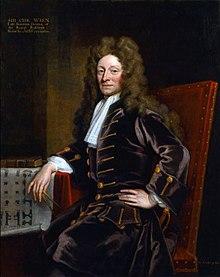
Sir Christopher Wren (1632-1723)
Sir Christopher Wren, architect of St Paul’s Cathedral and many other iconic public buildings, had a close relationship with Parliament, largely in relation to his architectural commissions, including refurbishing parts of the old Palace of Westminster itself. However he also sat in the House of Commons several times as a Member.
He twice failed to win a parliamentary seat early in his career, once for Cambridge University and once, with commendable Oxbridge fairness, for Oxford University. He stood in the Cambridge University by-election of 8 March 1667, but, despite having recently completed the building of the university’s Pembroke College chapel, he lost, though by only six votes (112-118).
Seven years later, he tried again in a by-election at his old university, Oxford, on 16 January 1674. As the favoured candidate of the Court, and a recently-knighted graduate of the University, who had had built its Sheldonian Theatre and had just given up his long-time professorship of astronomy there, he must have felt he was in a strong position to take the seat. However, he was decisively out-campaigned by his main opponent Thomas Thynne, who, it was later reported, kept ”an open table for the masters for a week or ten days, and went to the coffee houses to court stinking breaths and to the common chambers”. Wren, who ”was not so expert this way”, was easily beaten into second place, in a four-man field, with 125 votes to Thynne’s 203.
Wren finally entered the Commons in 1685, as one of two successfully nominated Tories in the 20 April election for Plympton Erle in Devon. He appears to have been an assiduous parliamentarian for the few months that James II’s Parliament actually sat before it was adjourned in July. He was nominated to 15 committees, including several directly relevant to his professional activities, including the creation of a new parish of St James, Piccadilly in Westminster; the licensing of hackney coaches (part of which revenue was to be applied to Chelsea Hospital, another of his buildings), and the rebuilding of St Paul’s.
He had been ‘reselected’ by the Court for Plympton in 1688 for the proposed elections to a new Parliament, which James II hoped to pack with supporters, but the ‘Glorious Revolution’ intervened. When the Convention Parliament was elected to decide on the future of the Crown, Wren was returned instead for New Windsor in Berkshire on 11 January 1689, tying on 12 votes with the other successful candidate, Henry Powle.
Unfortunately he became embroiled in the long-running disputes over the constituency’s franchise, with the losing candidates petitioning the Commons to overturn the election of Wren and Powle. The House endorsed Powle (who was their Speaker) on 2 May, but on 14 May it voted 107-72 to declare Wren’s election void, and for a writ to be issued for a by-election.
History repeated itself in the 1690 general election, when Wren was again one of the two successful candidates in the 6 March poll, and the losing candidates petitioned the Commons. Though the Committee of Privileges and Elections came out in favour of the sitting MPs, on 17 May the House itself rejected this recommendation and narrowly voted in favour of the two defeated candidates taking the seats. Wren’s only noteworthy contribution in these two brief periods in the House came the day before his second removal from the House, when he successfully cited an attorney, one Henry Carington, for breach of privilege in executing a writ of possession against several of Wren’s tenants.
Wren’s difficult professional dealings with both Houses in subsequent years – both over funding for his public building projects, and in relation to his work in the Palace of Westminster itself – may have induced him to consider a return to politics in 1701, when he seems to have been interested in the seat of Weymouth and Melcombe Regis in Dorset in the January general election.
In the end, he deferred to fellow Tory Henry Thynne (son of the Thomas Thynne who had defeated him in the 1674 Oxford by-election), but he stood in the second 1701 election and emerged as one of the twin-borough’s Members. He was not very active in this short Parliament and did not stand in the 1702 election caused by the death of William III.
Thus ended Wren’s rather intermittent parliamentary career. He was certainly not a party or parliamentary politician in the modern sense, but someone who found, as was common in that period, that a seat in Parliament was of value professionally.