
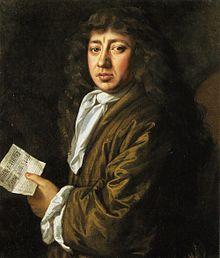
Samuel Pepys (1633-1703)
In addition to his periods as an MP, the public career of the great diarist, Samuel Pepys, was frequently interwoven with the English Parliament.
As a senior Navy official, Pepys had to defend the Navy Office before Parliament when it was under sustained criticism in 1667-68. This was a fearsome experience for a bureaucrat, and his Diary records that, en route to Westminster, “full of thoughts and trouble”, he fortified himself with half-a-pint of mulled sack in a local pub, and a dram of brandy in Westminster Hall.
Fortunately, his speech at the Bar of a “mighty full House” was a great success. One friend, Sir William Coventry, even welcomed him with “Good-morrow, Mr. Pepys, that must be Speaker of the Parliament-house.” Before long, the idea of a parliamentary career, so as more effectively to support the administration of the Navy, had taken hold: “My great design, if I continue in the Navy, is to get myself to be a Parliament-man.”
He did try to win a seat at the November 1669 Aldeburgh by-election. But the local corporation were unhappy at having “a stranger” foisted on them, and, in an ominous foretaste of future troubles, his rumoured Catholicism (his patron was the Duke of York, the future James II), fuelled opposition. Pepys’ enforced absence from the campaign by his wife’s illness and death, and further parliamentary attacks on the Navy, made his defeat unsurprising.
Pepys was more successful in a by-election in Castle Rising four years later, though support from his Catholic patrons, the Howard family, stoked local religious prejudice. Despite his patron’s confidence – ”You may depend upon it as done” – and Pepys’ protestations of his Anglicanism, he had to fight off a strong opponent, Robert Offley in the November 1673 poll.
The bitter and costly struggle continued, as the validity of his election was challenged on the grounds that he and his patrons were ‘papists’. This provoked heated debates in the Commons in early 1674, with Pepys having to deny these charges – which included an alleged remark that Anglicanism “came out of Henry VIII’s codpiece” – but luckily for him, no final decision was made, and the challenge fizzled out.
Pepys was neither a great parliamentarian, nor a political partisan, but he was effective in promoting the Navy, most notably in February 1677 when he persuaded Parliament to grant sufficient money for the building of thirty new ships. His specialisation, and his debating style, provoked criticism from other Members, one remarking that ”Pepys here speaks rather like an Admiral than a Secretary”.
He busily assisted other pro-government candidates around the country in the first general election of 1679. However, his offer to stand again for Castle Rising was spurned; he had to give up the chance of a Portsmouth seat, and also turned one down in the Isle of Wight, but won one of the Harwich seats after what he described as a “‘free, speedy, and almost charge-less election .. with a unanimity and excess of courtesy hardly to be equalled.”
The new Parliament was dominated by his enemies, who, during the hysteria fomented by Titus Oates’ fictitious ‘Popish Plot’ allegations, struck against perceived internal dangers to Protestant England. A reorganisation of the Admiralty led to Pepys losing his post as Secretary, and a parliamentary inquiry into alleged naval maladministration and Catholic influences was the pretext for imprisoning him in the Tower, where he languished for several months in 1679.
Though Pepys survived this crisis, he wisely declined to stand again for Harwich at the second 1679 general election. Nor did he contest the elections for the short-lived Oxford Parliament of 1681. But he gradually came back into favour in the early 1680s, when the succession of James became more likely. In the April 1685 election, following Charles II’s death, Pepys returned as MP for Harwich – having preferred it to Sandwich, where he had also been elected – and was active in James’ Parliament, even supporting some anti-Catholic measures.
However, as James became increasingly unpopular, Pepys’ failure to show sufficient anti-Catholic feeling lost him the support of his Harwich constituency at the election for the Convention Parliament following the accession of William and Mary. He was crushed at the 16 January 1689 poll, with only 6 votes to the successful candidates’ 27 and 22, marking the end of his parliamentary career.
Through his Diary, Pepys has bequeathed us many gems of political and social reportage. One relevant example from 7 February 1660 about the ‘Rump Parliament’: “Boys do now cry ‘Kiss my Parliament’, instead of ‘Kiss my arse,’ so great and general a contempt is the Rump come to among all the good and bad.” Crude perhaps, but memorable.