
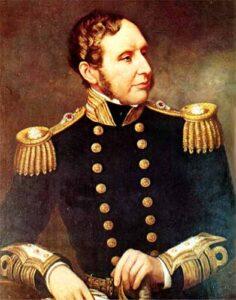
Robert Fitzroy (1805-1865)
Robert Fitzroy (sometimes FitzRoy) had a full and eventful life. In the 1830s, he captained the five-year voyage of the Beagle, where the naturalist Charles Darwin laid the scientific groundwork for his revolutionary ideas. He was later Governor-General of New Zealand. Finally, in 1854, he was the founding director of what became the Meteorological Office, later inventing modern weather forecasting, and was immortalised in 2002 by the shipping area Finisterre being renamed Fitzroy.
He also had time to be a Conservative MP between 1841 and 1843.
Fitzroy came from an illustrious political family, including a mid-18th Century former PM, the 3rd Duke of Grafton, and the famous Tory cabinet minister, Viscount Castlereagh, was his uncle. His father, Charles Fitzroy, had for many years been MP for Bury St Edmunds.
In the 1831 general election, fought over the Whig Government’s hugely controversial Reform Bill, Fitzroy stood as a Tory at Ipswich. He campaigned against parliamentary reform, claiming the Bill was unconstitutional. However, Ipswich followed the strong national reformist electoral tide, and convincingly rejected Fitzroy and his fellow anti-reform candidate.
It was after this political setback that Fitzroy undertook the famous Beagle circumnavigation, immortalised by Darwin’s presence. Ironically, Fitzroy was a convinced opponent of what became known as Darwinism, as being contrary to the Bible.
In 1841, a relative, Lord Londonderry, secured Fitzroy a nomination for the two-seat constituency of the City of Durham in the forthcoming general election. But then another Tory, William Sheppard, was unexpectedly also nominated. Even so, it was likely that Fitzroy, with Londonderry’s patronage, would be returned.
At first both Tories worked well together to secure a Conservative sweep. Then a voter let slip that he had been instructed by his landlord, Londonderry, to vote for Fitzroy, but not Sheppard. Sheppard took exception, even believing that Londonderry was urging votes for their Whig opponent rather than for himself, and withdrew from the contest so that he could make his disgust with Londonderry and Fitzroy public. Fitzroy then extravagantly attacked Sheppard’s withdrawal as a betrayal of their party.
Though these sensational events meant that, in the words of the Times, Fitzroy and his sole Whig opponent would be “quietly returned” at the poll, with no opposition, the Tory feuding escalated. A duel was even arranged between the two rivals, and then both parties published pamphlets setting out their respective sides of the affair. Even after it seemed that matters had cooled, there was an unseemly brawl between them, when Sheppard ambushed Fitzroy outside his London club in August.
Despite the election scandal, Fitzroy was an active new MP, largely speaking on matters on which he had some practical experience (especially maritime affairs), and serving on committees.
He received several signs of official favour. He was made Acting Conservator of the River Mersey, and wrote a report on it in 1842, and for several months at the end of that year he acted as aide-de-camp to the Austrian Archduke Ferdinand during his tour of Britain.
On 28 July 1842, Fitzroy made his greatest legislative contribution, when he introduced a Bill to regulate the masters and chief mates of merchant ships, a measure to improve safety at sea and to reduce the number of shipwrecks. Fitzroy knew his Bill had no chance of success, but wanted the opportunity to publicise the issue, a move recognised by the responding junior Board of Trade minister, one W E Gladstone. Fitzroy’s effort eventually bore fruit with Government legislation in 1850.
Fitzroy’s parliamentary career was cut short in early 1843, when he accepted the Government’s offer to become New Zealand’s second Governor-General. He was an obvious candidate, having visited the colony during his travels, and, in May 1838, had twice given evidence to a House of Lords select committee inquiring into New Zealand. Unfortunately, his term of office was not a success, and he was recalled in 1845.
Thereafter he was mainly occupied in maritime and meteorological affairs, rising to the rank of vice-admiral. However, his efforts were not wholly appreciated, and this gradually affected his physical and mental health. In April 1865, in a gruesome repeat of the 1822 suicide of his uncle, Castlereagh, Fitzroy ended his life by cutting his own throat.