
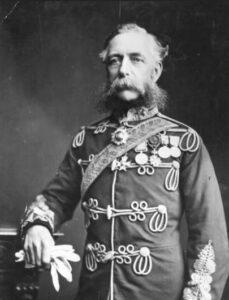
James Thomas Brudenell (1797-1868)
James Thomas Brudenell achieved immortality in 1854 when, as the 7th Earl of Cardigan, he commanded the Light Brigade in its heroic but doomed charge at the Battle of Balaclava during the Crimean War. Earlier in his colourful life, when mere Lord Brudenell, he was a Tory MP.
Marlborough was a two-seat borough controlled by a cousin, the Earl of Ailesbury, which regularly returned members of the Brudenell family. James’ father, the 6th Earl of Cardigan, arranged for Ailesbury to give his son one of its seats at the 1818 general election, even though young Brudenell was just short of his 21st birthday. The newly-elected MP then did what any young member of the upper classes in these days would do – the Grand Tour around Europe!
He was a fairly inactive MP, generally supporting Lord Liverpool’s reactionary Tory government, during a time of tense domestic unrest, opposing pro-Catholic and other reforms. In addition, Brudenell raised a troop of cavalry in Northamptonshire to oppose any insurrection. This was the start of a long military career, which meant that, as he himself later admitted, he “neglected much of his parliamentary duties.”
There was a rare contest in Marlborough in the 1826 general election, as a rival pair of candidates challenged Ailesbury’s nominees, in a dispute over 18 residents wanting to be added to its miniscule burgess franchise. At the poll, the ‘reformers’ votes were disallowed, and Brudenell and his colleague were returned with all of the eight valid votes cast!
By the end of the 1820s, Wellington’s Tory Government had accepted Catholic emancipation as the price of preventing rebellion in Ireland. Partly out of loyalty to the Government, and to Wellington personally, Brudenell supported this policy U-turn. However, his patron, Ailesbury, was resolutely anti-Catholic and forced Brudenell out of his seat in early 1829.
A year later, Brudenell purchased his return to the Commons through an unopposed by-election in the rotten borough of Fowey in Cornwall, and retained it a few months later at the 1830 general election. Unsurprisingly, he strongly opposed the new Whig Government’s parliamentary reform plans – including making what was probably his first, albeit very brief, Commons speech in July 1831 – but his efforts could not prevent Fowey being disenfranchised by the 1832 Reform Act.
Again he was forced to seek pastures new, and, at the December 1832 general election, he stood for the newly created two-seat Northamptonshire North. It was a spirited, sometimes bitter election. Brudenell stood as ‘the farmers’ friend’, supporting the Corn Laws which kept grain prices high. While campaigning in Wellingborough, he was ambushed by a mob, and his head was cut by a stone. At the poll, one Whig opponent, Lord Milton, accused him of “creeping up the back-stairs of every house to explain [his views] in private”, rather than speaking with electors publicly, a charge Brudenell promptly denied. The result saw him split the two opposing Whigs in a tight contest, with only 300 votes separating all four candidates.
He retained the seat unopposed in 1835, and held it until he entered the Lords as the Earl of Cardigan in 1837. However his parallel military career was controversial. Even while still an MP, in May 1836, his conduct was the subject of debate in the House, after an adverse court martial had highlighted his unpopular methods. Brudenell had to defend himself in a detailed speech before withdrawing from the rest of the debate.
His sometimes eccentric actions as a military commander often got him into trouble. In 1841, following a duel, Cardigan was arrested and opted to be tried by his peers – literally. His House of Lords trial was a notorious affair, but resulted in his acquittal on a technicality. Very shortly after, his decision to order the flogging of a soldier, convicted of drunkenness, to be held on Easter Sunday, and near a place where Easter services had just been held, caused outrage. Again, Cardigan survived, as the motion for a Commons inquiry was defeated.
Perhaps it is just as well for Cardigan’s reputation that his name is indelibly associated with the Charge of the Light Brigade (and with a type of sweater) than with his other military or political ‘highlights’.