
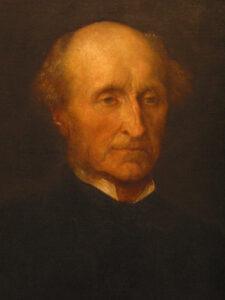
John Stuart Mill (1806-1873)
Like his father James, John Stuart Mill was a leading 19th century political and social philosopher. However, he took his theorising one step further when he became a Liberal MP for three years.
In 1823 he joined the East India Company as a clerk in his father’s office, where he rose to the post of Chief Examiner just before the Company’s abolition in 1858.
His growing fame as a radical campaigner encouraged the Irish Tenant League in 1851 to invite him to stand for them in an Irish constituency, but he politely declined, claiming that his post as a de facto civil servant disqualified him.
He confessed in his Autobiography that, though often urged by friends to pursue a parliamentary career, he thought it unlikely because of his radical views, and the need for a costly election campaign.
When invited to stand for the two-seat borough of Westminster in the 1865 general election, he accepted, though on his own strict terms. He saw the Commons as a useful platform, while disclaiming any personal ambition: “my only object in Parliament would be to promote my opinions.”
His absence abroad and growing controversy over his singular opinions risked defeat by the Conservative candidate, WH Smith (of newsagent fame). Coming over from France to participate in the campaign, however, seemed to work, and he was comfortably elected.
The new Parliament did not meet until the following February, when Mill, despite misgivings, took the religious oath as a new Member. He refused an invitation to a Speaker’s dinner, objecting to its strict, formal dress code.
Inevitably such a celebrated new Member provoked a backlash, and his initial forays in the Chamber – including his maiden speech on 14 February, and a later speech on the Bill suspending habeas corpus in Ireland, which vividly attacked British rule – were much criticised.
Disraeli derided him as “the finishing governess.” Even a fellow Liberal, Robert Lowe, said that Mill was “a little too clever for us in the House. He reasons with a degree of closeness and refinement which some of us, at least, are not quite accustomed to.”
After this poor start, Mill took his colleagues’ advice on parliamentary oratory, and, when on familiar topics, was more successful, though he complained about “the tiresome labour of chipping off little bits of one’s thoughts, of a size to be swallowed by a set of diminutive practical politicians incapable of digesting them.”
Many major speeches were in support of women’s voting and property rights. In May 1867, he boldly proposed a small but fundamental amendment to the franchise provisions of the Tory Government’s Reform Bill, replacing the word ‘man’ with ‘person’. Despite some inevitable ribaldry from the all-male House, he later described this as “by far the most important, perhaps the only really important, public service I performed” as an MP.
Mill also took a leading role in the controversial campaign against the former Governor of Jamaica, Edward Eyre, who had brutally quelled a rebellion in 1865, killing nearly 500 black residents. British opinion was split, but Mill, through his Jamaica Committee, denounced it as outright murder.
He took up the case in Parliament, and his Committee supported legal actions against Eyre, but they failed and Mill disbanded the Committee in 1868. When Gladstone, three years later, agreed to reimburse Eyre’s legal expenses, Mill wrote in disgust, “after this I shall henceforth wish for a Tory Government.”
Mill’s notoriety as an MP rebounded on him at the 1868 general election, when he was again opposed by WH Smith, and despite a sweeping Liberal victory nationally, Mill came last behind Smith and his fellow Liberal candidate.
He had spent much of the campaign supporting other radical candidates, even those standing against Liberals. Heavily outspent by Smith (by nearly £7,000), the Westminster Liberals unsuccessfully petitioned against Smith’s election on grounds of financial wrongdoing.
Mill rejected offers of other seats, and was glad to be able to focus more fully on his writing and public campaigning on issues such as women’s rights.
His time in Parliament was later summed up by Gladstone: “For the sake of the House of Commons at large, I rejoiced at his advent and deplored his disappearance. He did us all good.”