
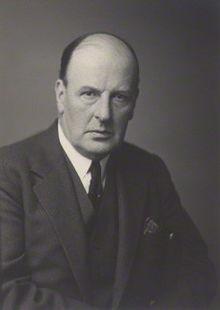
John Moore-Brabazon (1884-1964)
John Moore-Brabazon was an early 20th century Renaissance man. A noted aviator (the Bristol Brabazon plane was named after him), balloonist, racing driver, Cresta Run tobogganer, golfer and sailor, he squeezed in 25 years as an MP.
During the Great War, Lord Hugh Cecil, a fellow officer and Tory MP, suggested that he should go into politics. He applied for the nomination at Chatham, and his selection meeting in late 1918 was the first political event he had ever attended. Though not confident after his speech, he later found out that the selection committee chose him because of his brevity.
Not a professional politician, he found his first general election in December 1918 “one of the most ghastly nightmares”. This did not stop him winning the seat comfortably, with a majority of more than 7,000 over his Labour opponent, with the Liberal a poor third.
In his memoirs, he claimed that he made his maiden speech on the first day of the new Parliament. A slight exaggeration. The House met on 4 February, and Moore-Brabazon first spoke on the 12th during the King’s Speech debate. A keen flyer, he was upset at the Government’s plan to merge the Air Ministry and the War Office, under Winston Churchill, so he seconded an amendment opposing this downgrading of the developing field of aviation.
It was considered then rather bold for a new Member to speak so early. The Speaker, not amused at his presumption, gruffly told him later that “we have heard quite enough from you this session”, which Moore-Brabazon admitted was to a new Member was “a devastating remark.”
Despite this, Churchill swiftly made him his PPS on Air matters. Though rather afraid of his new boss, he “enjoyed dancing attendance on Winston very much”, and relished the governmental experience his new post gave him.
Moore-Brabazon retained his seat at the three quick general elections between 1922 and 1924, and, just before the 1923 election, was appointed a junior Transport Minister until Stanley Baldwin’s minority Tory Government fell the following January. When the Tories regained power at the October 1924 general election, Moore-Brabazon returned to his junior Transport post.
He was proud of his ministerial work during the 1926 General Strike. So he was understandably annoyed when the Prime Minister, Baldwin, said to him in the Commons lobby shortly after the strike: “Hullo, Brab, what have you been doing with yourself during the strike – playing golf?”
In 1927, viewing his post as a blind alley, and unhappy with Baldwin’s leadership, he resigned as a Minister. His Commons speeches grew more critical, as in a 1929 debate: “peace in our time does not necessarily mean somnolence on the Treasury Bench. The snores of the Government resound throughout the country. Elections are not won by snores.”
At the 1929 general election, when the Tories were ousted from power, Moore-Brabazon narrowly lost his Chatham seat to Labour. He looked elsewhere, but without success, mainly because of his antipathy to Baldwin.
Luckily, when the Tory MP for Wallasey decided just before the 1931 general election not to stand again, he was selected, beating a former MP, Herbert Williams. He then discovered that the vacancy had been arranged by the leadership to provide a seat for Williams, but the local party refused his offer to step aside, and he easily won the seat with a majority of over 32,000.
He spent most of the 1930s as a Government backbencher, opposing appeasement. In October 1940, Churchill, recently installed at No 10, reshuffled his government, making Moore-Brabazon first Minister of Transport, and the following May, Minister for Aircraft Production. For him, these were dream jobs.
His ministerial career ended abruptly in early 1942, when he was dropped in a further reshuffle. He attributed this to an incident in 1941 when some impromptu remarks of his at a private lunch were interpreted as hoping that German and Russian forces would destroy each other, allowing Britain to become masters of Europe. He had gravely embarrassed the Government at a critical time. A few weeks later, he entered the Upper House as Lord Brabazon of Tara.
Moore-Brabazon was not quite the high-flier in the Commons as he seemed to be at everything else.