
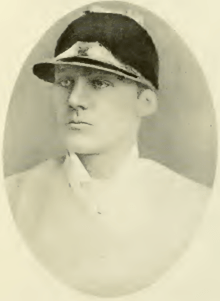
John Maunsell Richardson (1846-1912)
John Maunsell Richardson was a true Victorian sporting gentleman all-rounder. In first class cricket, he played 17 matches for Cambridge University between 1866 and 1868, and once for the MCC in 1874. He was also an active athlete, hunter and golfer.
But it was as a jockey that he was most renowned. John Buchan in 1924 claimed that “no greater gentleman-rider lived during the last half-century.” Known as “The Cat”, the peak of his riding career came when he won the Grand National twice in succession, in 1873 (on Disturbance) and 1874 (on Reugny), the latter his only ride of the year. Twenty years after his Aintree triumphs, he briefly served as Conservative MP for Brigg in Lincolnshire.
A north Lincolnshire native, he was urged by friends and family, especially his wife Victoria, Countess of Yarborough, to stand as a Conservative in the July 1886 general election at Brigg. North Lincolnshire was traditionally a Liberal stronghold, but in a strong Conservative national triumph, Richardson succeeded in reducing the previous Liberal majority of over 2,600 at the 1885 election to a mere 165.
It was even suggested that he could have won the seat if a distant female relative, who had significant patronage in the seat, had supported him, rather than his Liberal opponent, Samuel Danks Waddy. However, Waddy, a noted lawyer, had successfully represented Richardson’s relative in a notorious breach of promise case some years previously, and so he, not Richardson, was the beneficiary of her support.
Shortly after the election, his political opponents presented him with a saddle and bridle, saying: “We could not vote you a seat in Parliament, sir, but we have voted you a saddle on which we know you will have a safe seat as long as it hangs together, and a bridle you will know how to use.”
Richardson stood against Waddy again in the 1892 general election. He had worked hard in the constituency and won 300 more votes than in 1886. However the strong Liberal tide that returned Gladstone to power for his final term meant that he again lost the seat, this time by 427 votes.
When Waddy was given a judicial post in late 1894, Richardson stood in the subsequent by-election. The Liberals under Lord Rosebery were a weak and divided government, and had just lost a seat to the Opposition in the Forfarshire by-election, so the keenly fought Brigg campaign was of national importance, with regular press coverage, Punch cartoons, and leading politicians like Lloyd George and Walter Long speaking in the constituency.
The campaign was not without its personal as well as political dangers, as travel across rural areas in dark autumnal evenings led to Richardson’s carriage being involved in a road accident on 24 November, though he emerged shaken but unhurt. The result was announced on 8 December, and Richardson squeaked in by 77 votes, 4,377 to 4,300. As a local paper neatly put it, he had “steered another Disturbance to victory in the Grand National contest.”
Rosebery’s opponents in his own party took comfort from the result. Lewis Harcourt, politician son of Rosebery’s rival, William Harcourt, admitted in his diary for 8 December 1894 that he was “secretly … delighted. This must really be the beginning of the end and I hope this infernal Govt will be out early in February.” Another, Henry Labouchere, called it “one of the inevitable results of putting a second-rate nobleman at the head of affairs”.
Richardson made his maiden speech – in fact his only speech in the Chamber – on 15 May 1895, supporting a wrecking amendment to the second reading of the Land Tenure Bill. Intended to improve the rights of tenant farmers, the Bill was opposed by the landlord interest. He was cheered when he rose, and his speech was reckoned a success.
His wife and sister were in London to hear his maiden speech from the Ladies Gallery. Unfortunately, just as they arrived at the gallery, they were met by Richardson, who had just finished his speech. They had missed his great moment.
Weeks later, Richardson’s parliamentary career came to an abrupt end, when he was defeated at the July 1895 general election. Despite a strong national victory for the Tories, Brigg reverted to the Liberals by 776 votes, with Harold Reckitt polling 4,886 to Richardson’s 4,110.
After the defeat, Richardson was invited to stand in other constituencies, including some safe Tory seats that could have secured him a long parliamentary career. He turned them all down, out of loyalty to his native Lincolnshire: “If I am not good enough to represent the county in which I was born and bred, I will represent no other.” A fine principle for a Victorian gentleman.