
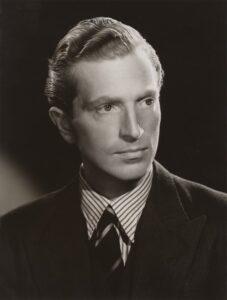
John Freeman (1915-2014)
John Freeman had a varied career. He edited the New Statesman in the early 1960s. He held two prime diplomatic posts, as High Commissioner to India and Ambassador in Washington. In broadcasting, he chaired LWT, and is probably best remembered for his ground-breaking BBC interview series Face to Face (1959-1962), where his astonishing range of guests included Carl Jung, Martin Luther King, Edith Sitwell and Adam Faith. He was also a Labour MP for a decade from 1945.
He stood at the July 1945 general election as the Labour candidate for Watford. Although Watford had been a safe Tory seat for years, the shock Labour landslide helped carry Major Freeman to a narrow victory over the incumbent Conservative by just over 2,000 votes.
The novice MP’s career got an immediate boost by being invited to move the Loyal Address at the opening of the new Parliament. On 16 August, in military uniform, he delivered what the Times described as “an admirable speech.” Freeman ended his maiden speech with an understandable flourish: “To-day, we go into action. To-day may rightly be regarded as ‘D-Day’ in the Battle of the New Britain.”
He was soon made a PPS, and by October 1946 was a junior War Office Minister. A year later he was transferred sideways to the Ministry of Supply. The unique atmosphere of the 1945 Parliament, especially the hostility of the Tories, in Opposition with their lowest total since 1906, was later recalled by Freeman: “I have not forgotten the tension of rising to answer questions or conduct a debate under the cold, implacable eyes of that row of well-tailored tycoons, who hated the Labour Government with a passion and fear…”
Despite his early rise, he remained a junior Minister after the 1950 election, which slashed Labour’s Commons majority. In February 1951, Churchill, the Leader of the Opposition, moved a censure motion attacking the controversial iron and steel nationalisation. Freeman delivered the wind-up speech, impressing the Tory MP and diarist, Sir Cuthbert Headlam: “Parliamentary Secretary, one Freeman, wound up for the enemy – a cock sure young man whom I don’t know but dislike intensely. He was good tonight – keeping his head among considerable noise.”
Then came his greatest political crisis. A left-winger, he was very unhappy at Hugh Gaitskell’s April 1951 Budget, with its novel imposition of NHS charges to help pay for rearmament at the time of the Korean War. Two senior ministers, Aneurin Bevan and Harold Wilson, resigned in a blaze of publicity, both making dramatic resignation speeches in the House.
The third ministerial resignation was that of Freeman on 23 April. He did not make a resignation speech, but his exchange of letters with the PM, Attlee, was published, in which he criticised the introduction of NHS charges and the scale of the rearmament programme, but promised his continued full support for the Government. The three rebels formed the core of the influential Bevanite Group.
Freeman held on to Watford by just over 500 votes in the October 1951 election which saw the Conservatives return to power. He stood down at the next election in 1955 to pursue his other interests, especially journalism. A wise move, as Watford fell to the Tories.
His old Bevanite colleague, Harold Wilson, by then Prime Minister, appointed him High Commissioner to India in 1965, and, expecting a Democratic success in the 1968 Presidential election, then nominated him as the next Ambassador to the USA. Richard Nixon’s victory came as a severe diplomatic blow, as Freeman had been a fierce critic of Nixon.
Nixon addressed this issue directly during some remarks at a Downing Street dinner in February 1969, shortly after his inauguration: “They say there’s a new Nixon. And they wonder if there’s a new Freeman. Let me set aside all possibility of embarrassment because our roles have changed. He’s the new diplomat and I’m the new statesman.” Wilson gratefully wrote to Nixon that it “was one of the kindest and most generous acts I have known in a quarter century of politics.”
He died of a chest infection just short of his 100th birthday at the Royal Star and Garter Home in Surbiton, Surrey.