
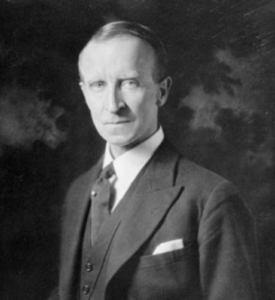
John Buchan (1875-1940)
One of the most popular novelists of the early 20th century, author of The Thirty-Nine Steps, John Buchan served for eight years in the House of Commons as a Conservative MP.
He had been politically active as a younger man, and was political secretary to the High Commissioner to South Africa, Alfred Milner, assisting in the post-Boer War reconstruction. He was a Tory, though he also had Liberal friends, and his political views were never really aligned to any particular party.
He didn’t stand at the 1906 or 1910 elections, despite some prompting by friends, partly because he could not afford it at a time when MPs were unpaid. He was adopted as a Conservative in March 1911 for the Borders seat of Peebles and Selkirk, then held by the Liberal, Donald Maclean (father of the spy). With the Tories’ protectionist policy receding, he felt, as a free-trader, able to support them again, though he admitted that he had still “a queer assortment of interests” politically. The local paper asked whether he was really a Liberal, suggesting that his views were “rather advanced” for some Tories.
He nursed the seat diligently for three years, enjoying the social side of electioneering: “It was not canvassing, for I rarely mentioned politics.” However the War postponed any election, and by 1918, he was too disenchanted with politics to pursue his candidacy. In 1914 he had considered standing in Oxford, because he feared his health made fighting the huge Borders seat impractical, but nothing came of that. He refused overtures in the early 1920s to stand for Peebles & Southern and in Glasgow Central (succeeding Bonar Law).
However, when a vacancy suddenly became available for the Scottish Universities on the death of the sitting MP Sir Henry Craik (Conservative), Buchan accepted the challenge. For him, the seat was ideal, being in Scotland, requiring minimal campaigning, with party loyalty was less necessary, and celebrity an advantage. In the April 1927 by-election, Buchan won nearly 88% of the vote, beating the Labour candidate, Hugh B. Guthrie, 16,963 to 2,378.
Unusually, his maiden speech, on 6 July, was on a controversial subject, House of Lords reform, and strongly against his own Government’s policy. Though he began speaking, with some trepidation, to an almost empty Chamber, his confidence grew as the House filled up. The customary congratulatory remarks of the following speaker came from Lloyd George, who waxed lyrical over “so brilliant, so wise, and so eloquent a maiden speech”. Fellow MPs and the Press were similarly impressed, and Buchan was tipped as a rising star.
His first attempt at lawmaking was unsuccessful, despite his Dog Racing Bill, dealing with the licensing of dog tracks, gaining a huge Second Reading majority on 11 May 1928. However, another Bill, five years later, did pass, as the Protection of Birds Act 1933. His speech on the Sunday Entertainments Bill in 1932 helped lead to the creation of the British Film Institute the following year
Though he was a regular attender at the House, and re-elected in 1929 and 1931 (the latter unopposed), he was not entirely comfortable as an MP. He had entered politics relatively late (he was 51 when he won in 1927), and retained his independence of thought over major issues. He tended to concentrate his efforts on a few subjects like Scotland, education and imperial affairs, and made some surprising friends, such as the Red Clydesiders on the Labour benches.
He described speaking in the Chamber as being “like addressing a gallery of shades, who might at any moment disappear into limbo unless they were clutched by the hair.” His literary background was regularly raised in the House. One Member opposed to his Dog Racing Bill called him a crank, and “once you are a crank, you are on the first of the 39 steps that surely lead to political extinction.” However, in his memoirs, Buchan concluded that “though I was an undistinguished Member of Parliament, I was a contented one.”
None of this prevented him from seeking ministerial office. Though he assured Stanley Baldwin in October 1932 that “politics have always been my chief interest”, Baldwin, more concerned with keeping party balance in the coalition National Government, privately thought that “Buchan would be no use in the Cabinet”. Despite this failure, he was an influential confidante of both Baldwin and Ramsay MacDonald, and did much work within the Conservative party organisation.
In 1935, he accepted the post of Governor General of Canada. Although he formally ceased to be an MP on 22 May, through the traditional route of being appointed to the sinecure office of Steward of the Chiltern Hundreds on that day, he seemed to have left Parliamentary life well before then.
The day after the appointment was announced on 27 March, he described to his mother the “very melancholy affair” of his staged departure, getting up from his seat at 2:59pm, shaking hands with Baldwin and MacDonald, and leaving the Chamber.
A contemporary story in Time describes Buchan having tea in the Commons that afternoon when the division bell rang, and a waiter reminded him of the need to go and vote. Buchan replied: “I ceased to be a member of this House at 3 o’clock this afternoon.” If this is fiction, it is a story worthy of Buchan the novelist.