
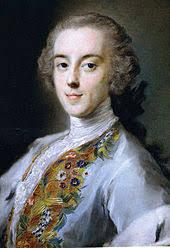
Horace Walpole (1717-1797)
Horace Walpole was a literary giant of the 18th century, and, being the son of Britain’s first and longest-serving Prime Minister, it was no surprise that he also sat in the Commons.
While on a Grand Tour of Europe, and only 23 years old, Walpole first became an MP. His family had arranged a seat at Callington in Cornwall, and, at the 1741 election, despite being opposed, he was comfortably returned. Typically, he didn’t need to appear in Callington. In fact he never visited it during the 13 years he represented it.
When the new Parliament met in December, and despite what Horace thought was a substantial majority, Sir Robert Walpole’s Government only lasted until the veteran PM resigned in mid-February. Sir Robert’s enemies moved for a secret committee of inquiry into his premiership, which prompted Horace’s maiden speech on 23 March in defence of his father. The inquiry was set up, but petered out.
Macaulay was scathing about Horace the politician: “After the labours of the print-shop and the auction-room, he unbent his mind in the House of Commons. And, having indulged in the recreation of making laws, and voting millions, he returned to more important pursuits. … About politics, in the high sense of the word, he knew nothing, and cared nothing.”
Walpole was obsessed by political intrigue, or, as he put it, he had a “Gothic passion … for squabbles in the Wittenagemot.” In that era, politics was an elite activity, prompted as much by family connections and valuable sinecures as by political philosophy. Well-placed and literary, Walpole was the ideal commentator, and he graphically described political events and people in his extensive correspondence, and, from 1751 to 1771, in his various Memoirs.
With a Whig ascendancy, divisions were as much between Whig factions as between Whig and Tory. Walpole was a nominal rather than a ‘sectarian’ Whig, and many targets of his literary barbs were Whig leaders, such as Henry Pelham and his brother, the Duke of Newcastle, who between them held the premiership from 1743 to 1762, bar a few months in 1756-7.
Horace was often classed as a Government supporter, and, for example, in January 1751 he accepted Pelham’s invitation to move the Loyal Address at the start of the new session. However, he voted against it when he thought it right, and intrigued regularly against the Pelhams and later PMs, though generally using others as his mouthpieces.
At the 1754 general election, he switched seats to Castle Rising in Norfolk, another family constituency. However, when his cousin was transplanted to the Lords on the death of his father, the voters in the new peer’s seat at King’s Lynn, wanting another Walpole, persuaded Horace to switch again. Assured of an uncontested by-election, he was returned unopposed in February 1757. King’s Lynn was a substantial town, unlike his previous seats, and Horace even had to participate in person in the 1761 election campaign, including a speech at the town hall.
During the brief interlude between Castle Rising and King’s Lynn, Horace, though not an MP, became involved in the cause célèbre of Admiral Byng. Initially believing in Byng’s culpability in the fall of the then-British island of Minorca to the French in 1756, he was persuaded, after Byng’s court martial and sentence of death, that he was being made a scapegoat by the Government. Walpole successfully lobbied behind the scenes at Parliament for a stay of execution, but he could not prevent Byng facing a firing squad on 14 March 1757.
At various periods, Walpole had temporarily ‘retired’ from active politics to pursue other interests, especially his writing, including his Gothic novel, The Castle of Otranto. By the late 1760s, he again wearied of Parliament, and retired at the 1768 election. He later wrote how delighted he was with “having bid adieu to Parliament and politics”, and not having to campaign “in the high fever of a contested election, which at best would end in my being carried about that large town like the figure of a pope at a bonfire”.
This was the end of his Commons career, though he remained an acute observer of politics, both at home and abroad, until his death.