
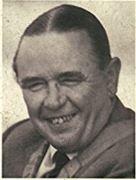
Henry Longhurst (1909-1978)
To readers of a certain age or a certain sporting disposition, Henry Longhurst was for decades Britain’s voice of golf in Britain. For 20 months during World War II, Captain H. C. Longhurst was also the Conservative MP for Acton in West London.
In the 1931 general election, Longhurst had spoken at a campaign meeting supporting Bedford’s Conservative candidate, which he described as “a heady introduction to politics, and once you have been bitten by the bug it is almost impossible, as in golf, to throw it off.” His political interest intensified during the War when, as an officer, he observed the ‘leftist propaganda’ of the Army Bureau of Current Affairs. This, and his connections with leading Tories of the day, made him determined to become a Conservative candidate.
So when the sitting MP for Acton died in late 1943, Longhurst applied, along with around 40 other hopefuls; was one of five interviewed by the selection committee, and emerged as the unanimous choice. This being wartime, he had to get special permission as a soldier to stand for Parliament. Wartime by-elections were unusual affairs, the three major parties having agreed an electoral truce for the duration, encouraging ‘fringe’ candidates standing in opposition to the war or to the Coalition Government.
There were three other candidates; the most serious being the anti-war Independent Labour Party’s Walter Padley (later a Labour MP and junior minister). As the Conservative/National Government candidate, Longhurst received Churchill’s public endorsement, and photos show him brandishing a poster declaring “Churchill asks you to vote for Longhurst”.
He was, however, rejected by the Communist Party (which generally supported Coalition candidates) as “utterly unfitted to represent the anti-Fascist views of the constituency”. And his personal appearance was not an unmitigated plus; he recounts that, when he was pasting up a poster representation of himself, a woman declared: “Bin all right if they’d left the face orf!”
Despite these handicaps, Longhurst easily won the 14 December poll, with 5,014 votes to Padley’s 2,336, with the other candidates gaining just under 1,000 votes between them. Two days later he arrived at Westminster to be sworn in.
He made his maiden speech on 23 February 1944, during a debate on the War. Knowing that the Speaker would call him around 2pm, he prepared with “a couple of cautious pink gins and no lunch”. Nevertheless, when the time approached, he realised he had completely forgotten not only the details of his speech, but also what it was about. He was tempted to flee the Chamber for another pink gin, or even to put it all off until another day.
However, when called by the Speaker, he seemed to survive his baptism reasonably well, opening with the usual self-deprecation about speaking “with all those uneasy emotions which older hon. Members will recall having experienced when they first addressed this House.” The traditional congratulations from the next speaker (Ipswich’s Labour MP, Richard Stokes) inevitably included a golfing allusion: “May I congratulate him on getting off the tee with such confidence…”
Most of Longhurst’s speeches and questions related to the War at home and abroad. Perhaps his most interesting contribution was an exchange with the Labour fire-brand, Aneurin Bevan, during a debate on 18 July 1944. Longhurst intervened during Nye’s speech to ask if he was “perhaps referring to the occasion in 1941 when he said the Russians would finish the war in a week.” Bevan bridled, denying he had ever said such a thing, and demanding Longhurst produce any evidence. Not having ‘chapter and verse’ with him, Longhurst promised to do so “at the earliest opportunity”, agreeing with Bevan’s demand for an apology if he could not do so.
In his autobiography, he recounts his embarrassment: “it was not long before I was wishing I had kept my mouth shut.” He recalled that the quotation arose when talking with Quinton Hogg in the House Library, but all attempts to contact Hogg by phone proved fruitless. He had to search through the previous five years’ Hansard to find it himself, before the debate ended. With barely half an hour left, he found it (from a 5 November 1940 debate), and despite some protests from Bevan that his words had been twisted, parliamentary honour was apparently satisfied.
Longhurst was swept away in the Labour’s 1945 election landslide, with 12,134 votes to Labour’s 19,590. He then secured the Conservative nomination for Bedford (which Labour had gained with a tiny majority of 288), and for a time actively nursed that winnable seat. However as the next election loomed, he realised he would have to give up his career as a golf correspondent, so, in 1949, resigned his candidature. He did have momentary regrets: “I drove back to London thinking, ‘A safe Conservative seat for life and you have thrown it away. You must be the biggest bloody fool in the whole of Britain!’”