
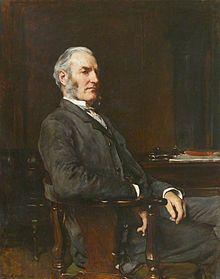
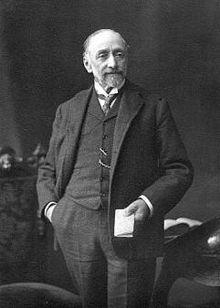
Edward Harland (1831-1895) & Gustav Wolff (1834-1913)
Though neither was an Irishman, Sir Edward Harland and Gustav Wolff, the eponymous owners of the renowned Belfast shipbuilding firm of Harland & Wolff, both sat in Parliament as Belfast MPs in the pro-Unionist interest.
The Yorkshireman, Edward Harland and Hamburg-born Gustav Wolff were very distantly related, which helped Wolff, in 1857, to get a job as Harland’s assistant with the Belfast shipbuilder where Harland was manager. They bought the Belfast yard as de facto partners in 1858.
By the late 19th century, when both had largely ceased direct involvement in the company, Ireland was at the forefront of British politics, with Gladstone trying to legislate for Home Rule against widespread opposition.
There were even suggestions that the company was considering moving to the British mainland if and when Home Rule was granted. In such circumstances, it was inevitable that major Ulster business leaders would become personally active in politics to protect their economic interests.
In 1886, when Harland was Mayor of Belfast, his firm, with a predominantly Protestant workforce, was at the heart some of the rioting. A Commons speech by Nationalist MP, Joseph Biggar, in September was typical in denouncing him as “one of the most extensive jobbers in the town of Belfast. … In his capacity of Mayor of Belfast [he] has acted as a gross partizan in connection with these riots.”
Harland moved into national politics when adopted as Conservative candidate for Belfast North, and, on the death of the sitting member in 1889, he was returned unopposed on 12 August. He was also unopposed at the July 1892 general election.
He was an active opponent of Gladstone’s second Home Rule Bill in 1893. He led a Belfast business deputation against it to Downing Street in March, and two months later spoke at a meeting of Unionists welcoming the Tory leader, Lord Salisbury, to Belfast, pledging “the determination of Ulster loyalists to resist to the last any dismemberment of the Empire.”
In the Commons, he spoke extensively against the Bill’s second reading on 21 April, declaring that he “did not see the slightest use for such a Bill,” and denouncing it as “the most uncalled-for, the most wanton, and the most revolutionary piece of legislation which had ever been offered to [the] House for its acceptance.”
In April 1891, Harland was appointed to the Royal Commission on Labour, to inquire into the state of industrial relations at a time of widespread trade disputes, and, in the florid words of its remit, to report whether legislation “can with advantage be directed to the remedy of any evils that may be disclosed.” The Commission sat for 3 years, and Harland was an active participant in its work, especially as a member of its Iron and Coal group.
Wolff entered Parliament in 1892 at a by-election. The vacancy was caused by the sensational expulsion of the previous Member for Belfast East for failing to appear personally in the House in relation to the alleged “commission of unnatural offences in Belfast.” Several Unionist factions sought to put up a candidate, and Wolff, as the official Conservative, had to defeat an independent Conservative at the 9 March poll.
At the formal nomination, his opponent’s agent challenged Wolff’s nomination on the grounds that, being German-born, he was an alien, but this objection was rejected on proof being produced that Wolff had become a naturalised citizen in 1886.
He was not opposed in the five following general elections, and sat in the House until his retirement prior to the December 1910 election. Like Harland, Wolff spoke on many economic and commercial issues, including those close to his own business interests, as well as on Irish constitutional affairs.
However, he found time to champion fellow Members fond of a smoke in Parliament. In February 1897, he asked for improvements in the “very inadequate accommodation” provided for them, and suggested allowing smoking in one of the Library rooms. The responding Minister rejected his proposal as impossible “without causing great annoyance and inconvenience to many.”
Both Harland and Wolff must have made some impact in Parliament, because, when both in Parliament together after 1892, they were nicknamed ‘Majestic’ and ‘Teutonic’ respectively, after two famous liners built by the firm in 1889.