
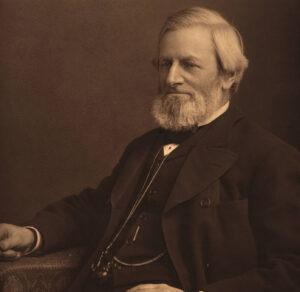
George Palmer (1818-1897)
George Palmer, co-founder of the famous biscuit manufacturers, Huntley & Palmer, was born on 18 January 1818 at Upton Farm, Long Sutton. His family, including his father, William and his mother Mary Isaac, were part of the village’s Quaker community. Mary had come from Sturminster Newton, Dorset to help a relative run the village shop. It was said that Mary Isaac (who was closely connected, on her own mother’s side, to the Quaker Clarks of Street, of the well-known shoe company) had made biscuits and regularly walked 7 miles to sell them at Yeovil market.
The family moved to Elberton, Gloucestershire, but in 1827, after his father died at 37 of heart disease, George was sent to Sidcot, the Quaker boarding school near Weston-super-Mare. He benefitted from the school’s emphasis on a practical education, and when he left in 1832, aged 14, he was apprenticed to an uncle, Robert Hitchcock, a miller and confectioner in Taunton. George was active in the community, especially in the town’s Mechanics’ Institution, and in 1838 he was involved in organising a public procession for Queen Victoria’s coronation.
After a year in Cardiff, he moved on to Reading in 1841 to form a partnership with Thomas Huntley, a cousin by marriage, and owner of a local biscuit-making company. In old age, George recalled that, while an apprentice at Taunton, he had bought some Huntley biscuits on a visit to Bristol and took them back to his master. This incident apparently fired his enthusiasm to join and develop this growing trade. The new Huntley & Palmer firm rapidly flourished, due largely to George’s technological innovations, by mechanising what was until then primarily a hand-made process of biscuit-making.
Quakers were famed for their many business enterprises, and one feature of this was their willingness to help each other out. For example, the aforementioned Clarks – a firm notorious for getting into financial difficulties, despite the generosity of their bankers, Stuckey’s of Langport – sought and received substantial financial assistance during a crisis in 1863 from various Quaker businesses, including the Palmers, and George’s brother, William Isaac Palmer, maintained a close interest in the Street firm’s progress.
George played a full part in civic affairs in Reading, as a Liberal Councillor, Mayor, and alderman. His mayoralty certainly began with a bang the day after his election. His supporters set off the town’s ceremonial gun, which was loaded, the explosion destroying many windows and burning local cornfields!
Though aged sixty in May 1878, he was urged to stand for Parliament following the death of one of Reading’s two Liberals MPs. The celebrated Quaker Liberal MP, John Bright, wrote to him: “Don’t allow the seat of Reading to be in danger – at this moment it is of first importance that no seat should be allowed to go over to the Government. Make some sacrifices for this if necessary.” Despite misgivings, he agreed and easily won the by-election, duly noted with some pride by the Somerset newspapers. The Bath Chronicle described his election victory as “the triumph of the biscuit tin”, while the Somerset County Gazette, in the course of a lavish panegyric, even marvelled at how he could “rise to greatness on a biscuit.”
He made his maiden speech in the Commons on 19 June 1878, supporting a private members’ bill on votes for women. He cited the case of “a widow who was left to rear up a large family” who, though “the most intelligent individual in the parish … was disqualified to vote simply because she happened to be a woman.” This widow was, in fact, his mother in her later years. Surprisingly, he changed his mind about women’s suffrage seven years later, but never explained why.
George was not an active parliamentarian, speaking so rarely that he became known as ‘the silent member’. He did not stand at Reading in 1885, because the borough had lost one of its two seats. Instead, he fought the new constituency of Newbury, but lost a tight two-horse race to his Tory opponent by 200 votes out of 9,000. That ended his political career. He died of a stroke in 1897 and is interred in Reading’s Quaker burial ground.
His son, George William Palmer, followed him as Reading’s MP from 1892-5 and again from 1898-1904, though he was, like his father, largely inactive in Parliament.
The Palmer family in Reading did not forget their Long Sutton roots, such as when donating for the creation of a free village library there in 1885. Many Palmers are interred in the Long Sutton burial ground, by the Meeting House (see accompanying image), including George’s grandfather and father, William Palmer II & III respectively. When a statue to George was unveiled in Reading in 1891, the Taunton Courier proudly reported this honour to a “successful Somerset man … an old Tauntonian and a native of Long Sutton.”