
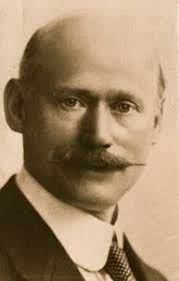
Frank Hornby (1863-1936)
Frank Hornby was the creator of some of this country’s most iconic toys – Meccano sets, Hornby trains and Dinky cars. For four years in the 1930s, he also was a Conservative MP for a seat in his native Liverpool.
He had helped found his local Conservative Association in 1912, but his decision to seek election to Parliament in his late 60s was probably more a social than a political move. The severe economic crisis of the early 1930s left Ramsay MacDonald’s Labour government floundering, and coalition seemed inevitable. A successful manufacturer, Hornby had a close interest in these developments, as a committed protectionist.
His nomination for the 1931 election, for the Liverpool Everton constituency, as a Conservative supporting the new National Government coalition, was not without controversy. The incumbent Labour MP had dithered about supporting MacDonald’s largely Conservative coalition, and by the time he had decided to stand again, Hornby had been nominated by the local Conservatives. Under the coalition pact, Hornby should have made way for the sitting MP, but he refused to do so, and though the national party leadership under Stanley Baldwin could not openly endorse him, he fought the seat as a Conservative supporting the National Government, under the slogans, ‘A Liverpool Man for a Liverpool Seat’ and ‘Vote Solidly for Frank Hornby, The Man You Can Trust!’. In a turnout of 71.3%, Hornby won 12,186 votes (48.9%), and a comfortable majority of 4,400. The National coalition won an enormous victory, with 554 seats, of which 473 were Tories.
With a large business to run in Liverpool, Hornby was not a frequent participant in Commons business. When he did so, it tended to be on matters of trade (especially within the Empire), unemployment and the dole, though generally not directly in support of his own toy industry, and he was a loyal voter in the Government lobby. His first written parliamentary question, on 14 March 1932, was on the financial position of sugar-beet factories in the Dominions, and his first oral PQ, on 11 April 1932, concerned the burden of local public assistance for those unemployed who did not qualify for national insurance benefits.
It was not until 4 November of that year that he made his maiden speech, during a debate on unemployment. He took a protectionist stance, but also used his expertise as an employer in the depressed areas to make some suggestions to stimulate trade and support the unemployed. It was a relatively brief maiden speech, not one likely to set the political world on fire.
Hornby’s substantive contribution to the 1931 Parliament was his attempt to introduce a Private Member’s Bill on 24 July 1934. His proposed Christmas (Facilities) Bill aimed “to extend the facilities for shopping during the Christmas season..”. This was not entirely altruistic, as it provided not just for extended shop opening hours in the fortnight before Christmas, but also for what he described as “the release of children from school during such period” who could use this time to “visit the shops and inspect the exhibited displays of British-made goods and material of a scientific nature, for after-school occupations.” What sort of goods could he possibly have in mind?!
This speech demonstrated that Hornby was not a seasoned parliamentarian. He was interrupted early on by a point of order from the Labour MP, Will Thorne, complaining that Hornby was reading his speech, contrary to House rules. Fortunately for Hornby, Speaker Fitzroy was indulgent, suggesting that “the hon. Member has, I think, what is very usual, rather extensive notes.” This did not stop Thorne remarking a few moments later that “these are very extensive notes”. Hornby’s motion was opposed by the Labour MP, Rhys Davies, who began: “The hon. Member for Everton intervenes so seldom in our Debates that I am rather reluctant to oppose his Bill, but I am going to do so.” Hornby was given leave by 115-101 to bring in his Bill, but nothing more came of it.
Ill-health and age prompted Hornby to retire from political life at the end of the 1931-35 Parliament. He died in September 1936, aged 73.