
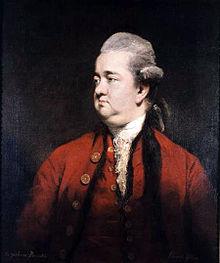
Edward Gibbon (1737-1794)
Edward Gibbon was an eighteenth century writer and historian, whose most enduring work was the multi-volume The History of the Decline and Fall of the Roman Empire. But for nearly a decade, Gibbon was also a Member of Parliament, and was present in the Commons during a critical point in British history, the American War of Independence.
As a writer, he has left us fascinating, eminently quotable first-hand accounts, especially through his letters and Autobiography, of parliamentary and political life in the 1770s and 1780s.
Gibbon’s father, also Edward, was a Tory MP, for Petersfield (1734-41) and then Southampton (1741-47). Of the 1741 Southampton election, Gibbon wrote that it was “an expensive and successful contest”, where, despite the rival Whigs having a majority of the resident vote, the firm support of the local corporation, and “a sudden creation of one hundred and seventy new freemen”, turned the scale.
His father wanted Gibbon to be an MP, and tried to buy him a seat for £1,500. Gibbon wasn’t keen, and just before the 1761 general election, wrote to his father outlining his deficiencies for a parliamentary career. However, he was manoeuvred into being an unexpected candidate for Petersfield, when some local freeholders tried to draft his father to stand.
“My father declined in my favour. I had never any opinion of the affair, and was only comforted by the reflexion that it cost hardly anything. One Barnard of Alresford made me lose the election or rather gave me an opportunity of giving it up with honour. …..The election came on. I in a set speech thanked my friends, abused Barnard, and declined a poll.”
However, when another opportunity came along thirteen years later, Gibbon took it. A distant relative, Edward Eliot, who controlled six seats, visited Gibbon in September 1774, while the latter was working on his Decline & Fall (“destroying an army of barbarians”), and offered him a seat, even suggesting that they share equally the expenses (£2,400), with Gibbon able to defer payment of his share.
Gibbon confessed in a letter that “I am ignorant whether my Borough will be Leskeard or St Germains.” He didn’t need to campaign in Liskeard, the chosen constituency: “the election will be over before I can get there. Indeed, as I can have no interest there but [Eliot’s] assistance .. his presence alone is necessary or useful.” On 14 October 1774, he heard that he had been elected, but seemed mainly interested in when the privilege of franking (ie free postage) would begin.
He arrived at Westminster in early December 1774, and ‘mugged up’ on the major issue of the time, the growing American rebellion. Though generally a public supporter of Lord North’s Tory Government on America, his private doubts about the wisdom of Government policy gradually increased. In 1777, after the British defeat at Saratoga, he wrote:
“.. I shall scarcely give my consent to exhaust still further the finest country in the world in the prosecution of a war from whence no reasonable man entertains any hopes of success. It is better to be humbled than ruined.”
If Gibbon’s parliamentary ‘career’ is known for anything, it is for his complete silence in the House throughout. While some new Members “lost their maidenheads with very little credit” in the early debates in December 1774, Gibbon, despite being “once or twice a little lewd” was glad he “resisted the premature temptation” to speak. The following month he was still hopeful: “.. if my confidence was equal to my eloquence, and my eloquence to my knowledge, perhaps I might make no very intolerable speaker. At all events, I fancy I shall try to expose myself.”
In February 1775, he admitted in a letter that “I am still a mute; it is more tremendous than I imagined; the great speakers fill me with despair, the bad ones with terror.” The following month he wrote to his stepmother:
“As yet I have been mute. In the course of our American affairs, I have sometimes had a wish to speak, but though I felt tolerably prepared as to the matter, I dreaded exposing myself in the manner, and remained in my safe seat, but inglorious. Upon the whole, (though I still believe I shall try), I doubt that Nature .. has given me the talents of an Orator…”
In his autobiography he explained his silence: “After a fleeting illusive hope, prudence condemned me to acquiesce in the humble station of a mute. I was not armed by nature and education with the intrepid energy of mind and voice. .. Timidity was fortified by pride, and even the success of my pen discouraged the trial of my voice.” He was careful not to risk any public ridicule that could prejudice his growing literary reputation.
In his early parliamentary years, his views of Westminster were relatively positive. As a Roman historian, he likened it to the Senate of the Roman Republic, and often referred to his position as that of a ‘Senator’. Though never speaking, he took his role seriously, and attended regularly, even the late-night sittings:
”I assisted at the debates of a free assembly; I listened to the attack and defence of eloquence and reason; I had a near prospect of the characters, views, and passions of the first men of the age.”
Generally a Government loyalist – in 1775, he admitted that “on the subject of America, I have been something more of a courtier” – he did consider his vote carefully, and sometimes rebelled. Horace Walpole thought his voting record “whimsical” because “he votes variously as his opinion leads him” and in 1779, the Public Ledger noted:
“He follows the dictates of his own opinion, voting sometimes with Government, and sometimes against, and lives in good friendship with all parties.”
He regarded his membership of Parliament as part of a well-rounded existence, in addition to his writing and his social life. He soaked up all the gossip, and, in a letter to his stepmother on 31 January 1775, he described the House of Commons, in a memorable phrase, as “at least a very agreeable coffee-house”. Though he soon tired of the Westminster grind, he did say, in his autobiography, that “the eight sessions that I sat in parliament were a school of civil prudence, the first and most essential virtue of an historian.”
However, Parliament was also important to him as a route to greater income. In these days, sinecures and public ‘places’ were regularly given to government supporters – practices attacked by Edmund Burke’s plans for ‘economical reform’. Gibbon sought an ‘honourable and advantageous post either at home or abroad’ which would defray his expenses, and had no desire to remain in the House without such patronage. Eventually, in 1779, he was made a Lord Commissioner at the Board of Trade, worth £800 p.a.
Gibbon was reasonably diligent at this job, attending 117 meeting over the three years he held the position. Nevertheless, when the post was eventually abolished in 1782, Gibbon’s interest in Parliament vanished also. “As a matter of curiosity I shall derive some satisfaction from my silent seat, but at present I do not perceive its use in any other light” (letter, 7 November 1782). In a letter to his stepmother the following July, at the end of his Westminster tenure, he was philosophical and honest:
“A seat in parliament I can only value as it is connected some official situation of emolument; that connection which has fortunately subsisted about three years is now dissolved, and I do not see any probability of its being speedily restored.”
Despite this ennui, Gibbon was still upset when he lost his Liskeard seat when his patron, Eliot, moved towards the opposition and unexpectedly withdrew his support in 1780. Gibbon had hoped that Eliot, despite his political shift, would continue to support him personally for Liskeard. In his pleading letters to Eliot in 1779-80, he was frank about the monetary motivation for his desired re-nomination, and, throughout these months, he was unsure whether Eliot would stick with him.
Eventually, in August 1780, Eliot told Gibbon that all his seats would go to the Opposition, claiming that the voters of Liskeard would not, in any case, re-elect Gibbon. This prompted an aggrieved but dignified reply from Gibbon defending his parliamentary actions. He then had to scramble for a seat for the September 1780 general election. He begged the PM himself, Lord North, for a seat, though, pleading poverty, he could afford nothing more than “an almost gratuitous seat”. The Government promised him a constituency, when one became available after the election. In his letters, Gibbon affected unconcern over a return to the Commons, though his anxiety is clear:
“I have the strongest reason to believe that I shall be again in the House of Commons before Christmas. I expect the event with the most tranquil indifference: I am heartily tired of the place. And if such indulgence were compatible with my situation and prospects I should be glad to find myself released from such troublesome attendance.”
Eventually he was returned for Lymington, Hampshire in June 1781, in what then passed for a by-election (following the death of one of the sitting Members), as he described in a letter to his stepmother in July: “.. there has been no other delay in my business, than the necessary forms of election. My new constituents of Lymington obligingly chose me in my absence.”
His letters over the next couple of years reveal his growing disenchantment with Westminster, which he described as “the Pandaemonium”, especially after he lost his Board of Trade job in 1782. He complained of the “heat and length of the Session” and the “late, hot melancholy hours of the House of Commons.” With prospects of any further lucrative patronage fading, emigration to his beloved Lausanne in Switzerland, to complete his Decline and Fall, became increasingly attractive and possible.
By 1783, he had decided to give up his seat, hoping that he could ‘sell’ it for a substantial sum. Even these hopes were dashed as an early dissolution of Parliament loomed without any sale in prospect, even at an ever-reducing asking price – “.. the £1100 or £1000 for Lymington (for we must not haggle about trifles)..”, as he wrote from Lausanne to his friend and ‘seat-broker’, Lord Sheffield, on 20 December 1783.
Pathetically, he pleaded with Sheffield in April 1784, about his “little hopes for compensation. Can nothing, nothing be done in any way by direct or indirect, by humble or strenuous measures? Upon my soul, I should consider my election dinner, £100 or £2000, as a tolerable conclusion of my cursed political life.” He was unaware that Parliament had already been dissolved in late March.
In his autobiography, Gibbon recalled his relief at being “delivered from the claim of duty and dependence, from the hopes and fears of political adventure; my sober mind was no longer intoxicated by the fumes of party, and I rejoiced in my escape as I often read of the midnight debates ..”
He graphically contrasted his new idyll in Lausanne with his past life at Westminster in a letter to Sheffield on 14 November 1783:
“.. you went to the House of Commons, and passed the afternoon, the evening, and perhaps the night, without sleep or food, stifled in a close room by the heated respiration of six hundred politicians, inflamed by party and passion, and tired of the repetition of dull nonsense, which, in that illustrious assembly, so far outweighs the proportion of reason and eloquence. On the same day, after a studious morning, a friendly dinner, and a cheerful assembly of both sexes, I retired to rest at eleven o’clock, satisfied with the past day, and certain that the next would afford me the return of the same quiet and rational enjoyments. Which has the better bargain?”
Who indeed?