
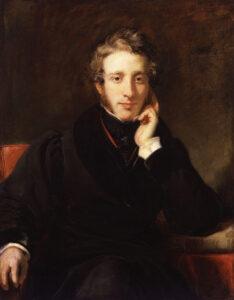
Edward Bulwer Lytton (1803-1873)
Edward Bulwer Lytton was a famous Victorian novelist; the author of the immortal line, “the pen is mightier than the sword,” and of literature’s most famous opening sentence, “It was a dark and stormy night.” In the mid-19th century, he was also a Member of Parliament.
Bulwer (as he was known until the 1840s) did not stand for Parliament in 1826 because he thought it would not last long due to the King’s health. If he could not buy a seat, “I shall try hard for the next two or three years to acquire a literary reputation and come in with the next Parliament.”
In 1831 he was returned unopposed for St Ives in Cornwall. He had secured the patronage of one of its sitting members, thereby fulfilling his stated desire to contest a seat only “with the fullest and fairest probability of success at a moderate expense.” He was at this time an independent Radical, supportive of the Whig Government’s attempts to secure parliamentary reform. On 5 July 1831, he made his maiden speech in favour of the Second Reading of the Reform Bill, even though its provisions would mean the loss of one of St Ives’ two seats. As a result, in the December 1832 election to the reformed House of Commons, Bulwer had to look elsewhere for a new seat. Invited by several areas, he chose Lincoln, and was returned safely, holding the seat until 1841.
In the House, Bulwer spoke out on many issues of social reform, including those close to his literary interests, such as copyright, censorship of plays and stamp duties on the press. The last formed part of his campaign against what he called ‘taxes on knowledge.’ Though he was not a compelling parliamentary orator, many of his causes did eventually come to fruition.
His own pen was politically mightier than his voice, as when he wrote a pro-Whig pamphlet, when they were dismissed from office by the King in late 1834. A best seller, it was influential in securing their success in the 1835 general election, and their return to power a few months later. A grateful Government offered Bulwer a Junior Lordship of the Admiralty, but he declined, notionally to prevent interruption to his literary work, but probably because he did not wish to give up being an independent Member.
However, his Radical credentials were fading, as he did not support the progressive policies of free trade and further parliamentary reform. His opposition to the abolition of the Corn Laws led to his defeat at Lincoln in the 1841 general election.
He failed to regain the seat in 1847, and this marked the effective end of his Radical-Liberal political phase. He was becoming more sympathetic to Disraeli’s brand of Conservatism, and it was as a Tory that he returned to Parliament in the 1852 general election as a Member for Hertfordshire.
When the Tories were in office in early 1858 as a minority government under Lord Derby, Bulwer was offered the Colonial Office, but he demurred, fearing the outcome of the necessary by-election, although a few months later a mini-reshuffle made him Colonial Secretary anyway.
The by-election led to an embarrassing incident, when his victory speech was interrupted by his wife, Rosina. They had separated bitterly in 1836, provoking a very public vendetta thereafter.
One report suggested she cried: “Fiend, villain, monster, cowardly wretch, outcast. I am told you have been sent to the colonies. If they knew as much about you as I do they would have sent you there long ago.” Bulwer retaliated by having her committed to an asylum, though her friends secured her speedy release and their feud continued until his death.
His ministerial career was brief, ending with the fall of Derby’s administration the following June. Though he clearly did not enjoy being a minister, and complained of ill-health, his tenure as Colonial Secretary was productive, especially in constitutional reforms in Canada and Australia.
Bulwer retained his Hertfordshire seat until 1866 when he accepted a peerage. Appropriately, given the topic of his maiden speech 35 years previously, his final speech in the Commons in April 1866 was again on the Second Reading of a Parliamentary Reform Bill.