
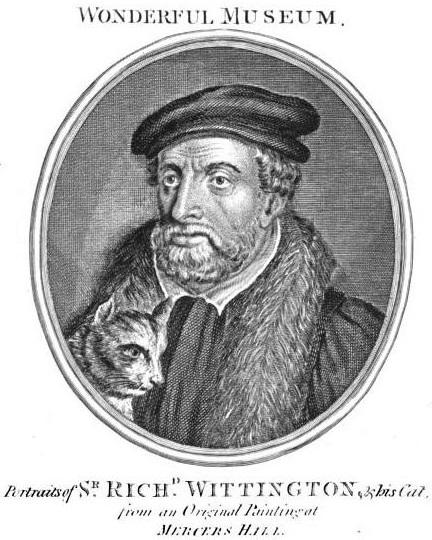
Dick Whittington (c1350-1423)
“Turn again, Whittington, thrice Lord Mayor of London! Turn again, Whittington, thrice Lord Mayor of London!” – and once a Member of Parliament for London. It is fairly well-known that the real-life person behind the pantomime character was actually a wealthy merchant and civic magnate in medieval London. What is not often mentioned, sometimes not even in the biographies, is that Richard Whittington served as one of the City’s MPs in the second Parliament of 1416.
Whittington came from an eminent Gloucestershire family that had a tradition of parliamentary service as MPs for the county. His grandfather, William, sat in the 1327 Parliament, and his father, Sir William, in the 1348 Parliament. His two brothers continued the tradition, William in October 1377, and Robert no less than six times over 30 years (in November 1384, 1391, January 1404, 1406, 1411 and April 1414). Robert’s son, Guy, sat in four later Parliaments (1420, May 1421, 1427, 1432), and Guy’s grandson, another William, represented Gloucestershire in 1455. Thus Dick did not sit in the same Parliament as any of his closest relatives.
Dick was a prominent civic and commercial figure in London life for around 30 years, as a leading figure in the Mercers Company, with the pinnacle being his three terms as Lord Mayor of London in 1397, 1406 and 1419. He was close to successive Kings during the period, both as a supplier of goods and money. He was personally appointed to the London mayoralty the first time by King Richard II, a highly unusual step, and was made a member of King Henry’s IV’s council in 1399. It seems that Whittington’s activities were motivated not so much by financial profit, but through a desire to participate directly in the city and nation’s political affairs.
Although he only sat in one Parliament, that which met at Westminster in October and November 1416, he was active in London’s parliamentary election processes (hardly a democratic exercise in these far-off days), attending six such elections in the last decade of his life. London sent two aldermen and two commoners to each Parliament during this period, and Whittington attended at Westminster in the autumn of 1416 as one of London’s aldermen. Most of London’s representatives tended to sit in only one Parliament around this period, so Whittington’s sole term was not unusual, even for such a prominent City figure, though, at 65 or so, he was rather older than the average London MP.
At least part of the reason for his return in the October 1416 Parliament at Westminster may have been a dispute involving Robert, his older brother, and Robert’s son, Guy, both of whom were still in the West of England. Robert and Guy were ambushed near Hereford in late October and held for ransom. Though speedily released, they presented a petition to Parliament, probably with the assistance of Dick, complaining about their mistreatment. It has also been suggested that some of Whittington’s fellow Mercers Company colleagues had a direct stake in some House business, over a matter concerning the Master of the Mint at the Tower of London, so he may well have wished to participate to protect their interests, if necessary.
So although he is known to us as Dick Whittington, as seen in numerous theatres around the country every year, he also had, as Richard Whittington, one engagement (even if without his legendary cat) at a much more august ‘Palace of Varieties’.