
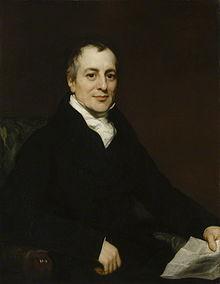
David Ricardo (1772-1823)
David Ricardo was already a famed theoretical economist and financier in the early 1800s, when he became, for the last years of his life, a Member of Parliament for a rotten borough.
A parliamentary seat had been suggested to him for some years, as a natural extension of his career. He had grown more active as an economic adviser to the opposition Whigs, and in 1814, James Mill, the famous philosopher, described Westminster as a place where “his tongue as well as his pen might be of use.” When Mill repeated his proposal the following year, flattering him that he could “improve that most imperfect instrument of government”, Ricardo demurred: “My inclination does not in the least point that way. Speak indeed! I could not, I am sure, utter three sentences coherently.” In similar vein, he rejected an approach in 1816 to stand for Worcester.
However, he gradually became more enthused about the Commons, and his election to Brooks Club, a noted resort for opposition politicians, in early 1818 was a visible sign of his ambition. Looking around for a suitable seat, he rejected several including Wootton Bassett and Fowey, partly because of the financial and other negotiations required in those days of rotten boroughs.
After Ricardo declined Worcester in 1816, Mill had written that ‘If I were in your situation, the rottenest Borough I could find would be my market, with nothing to do but part with a sum of money.’ This came to pass when lengthy negotiations were held through 1817 and 1818 on his behalf for the Irish rotten borough of Portarlington, controlled by the cash-strapped Lord Portarlington. When these discussions appeared to have broken down, largely due to the Earl’s fear that Ricardo would be an oppositionist, the incumbent, Richard Sharp, was returned again in the intervening general election in 1818. Ricardo found it all tiresome, and declared himself pleased to have not obtained a seat: “the certainty of a seat could hardly compensate me for the disagreeables attending the negociation for it.”
However, shortly after the election, a deal was finally reached with Portarlington. Ricardo loaned the Earl £25,000 at 6% interest, and ‘purchased’ the parliamentary seat for 4 years for £4,000 (with an ‘option’ for a further 3 years, if the Parliament ran its full term). Sharp stood down, and Ricardo was formally returned in his place on 20 February 1819, taking his seat in the House 6 days later. Though regarded by the Whigs as one of them, Ricardo had never regarded himself bound by any formal party political restrictions: “I should neither be Whig nor Tory but should be anxiously desirous of promoting every measure which should give us a chance of good government.”
Ricardo started a minor dynasty in the House. Two of his sons became MPs: Osman (Worcester, 1847-65) and David (Stroud, 1832-33), as did a brother, Samson (New Windsor, 1855-57); a nephew, John Lewis (Stoke on Trent, 1841-62), and a brother-in-law, William Arthur Wilkinson (Lambeth, 1852-57).
Other constituencies tried to tempt him away from Portarlington. Prior to the 1820 General Election, there were suggestions of a move to Gloucestershire, but he declined to “soar so high”, describing himself as “the most unfit of all men to engage in so perilous an undertaking” as fighting a county seat controlled by “an old and powerful family” (ie the Duke of Beaufort). In 1822, he was suggested for the forthcoming Liverpool vacancy when George Canning was stepping down, but again demurred, modestly saying that he was “unfit both for the contest, and for the dignity you would confer on me,” and that, if he stood and won, Liverpool would have “an inefficient representative.”
He stuck with Portarlington – he described his constituents as a “very good tempered set of gentlemen” whom he was sure would re-elect him “without hesitation” – even though, as a supporter of parliamentary reform, he realised such constitutional change would almost certainly mean the loss of his Irish rotten borough.
Both Ricardo’s first committee appointment, on 1 March and first recorded speech on 25 March were on aspects of the Poor Laws. He also spoke out on the extension of the franchise, free trade and abolition of flogging, and was highly critical of the Government’s draconian public order policies, especially after the notorious ‘Peterloo Massacre’ in 1819.
His main focus however was economic, especially the controversial Corn Laws and various arcane, but vital, issues of the currency. He also pressed, probably as much for his professional as his representative purposes, for better preparation and publication of Government economic statistics and accounts, complaining, for example, in a speech in February 1822, that existing data made it “impossible that the Members of that House could come to any knowledge of the real state of the country”.
His many speeches on these matters were often in highly technical detail, which caused the parliamentary reporters of the day great difficulty, as he recognised: “‘It is a great disadvantage to me that the reporters not understanding the subject cannot readily follow me—they often represent me as uttering perfect nonsense”.
His last recorded speech in the House was in July 1823, and he died that September, aged only 51. Despite his short tenure, Ricardo’s obvious expertise made him an important and influential member over the main economic questions of the period, as the many tributes from political friend and foe alike attested.