
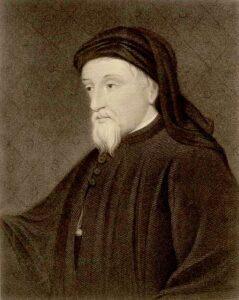
Geoffrey Chaucer (c1343-1400)
Geoffrey Chaucer is the most famous English poet of the medieval era, and even those who have never read or studied him will know of his masterpiece, The Canterbury Tales. Chaucer also had a long career of public service, and was in the royal household of two kings, Edward III and Richard II. He was, for over a decade, a controller of customs in London, and was a justice of the peace in Kent. In the autumn of 1386, he was also an MP.
Chaucer was one of the two knights returned for Kent (the other being a William Bettenham, who was also returned in 1388) for the Parliament which met from 1 October to 28 November 1386 – the so-called ‘Wonderful Parliament’. Though not a Kent native, and without any great estates there, he was probably staying in the county around this time, in connection with his various public duties. However, his election, in August or September, was likely due less to his local connections or personal influence, than to the royal patronage he enjoyed. The local magnates who, in those far-off days, determined parliamentary elections, would have sent him to Westminster to support the King in his political struggles.
Though there is no record of Chaucer’s activities in Parliament, there is some evidence in court records of his attendance at Westminster at the time it was sitting, as well as an order issued on the day of Parliament’s dissolution (28 November) for payment of his expenses for his 61 days’ attendance. The Wonderful Parliament was one stage of the bitter in-fighting between the King and some of his senior nobles. A Parliament dominated by the ‘Opposition’, focussed its criticisms on government maladministration and corruption, which may have led to Chaucer, a known ‘king’s man’, rapidly giving up his customs controllership in December 1386.
There are some parliamentary references in Chaucer’s poetry, although the difficulties in dating his works exactly mean we do not know whether they derive from his direct experience in 1386. Examples are his dream poem, The Parliament of Fowls; the ‘Trojan Parliament’ episode in Book IV of Troilus and Criseyde, and the description of the Franklin (a free-hold landowner) in the Prologue to the Canterbury Tales as someone who had various civic and public roles, including “Ful ofte tyme he was knyght of the shire”.
His son, Thomas Chaucer, was a far more experienced parliamentarian, representing Oxfordshire in more than a dozen Parliaments over the first three decades of the 15th Century, and acting as Speaker of the Commons no less than five times – unlike Geoffrey, not just a one knight stand.