
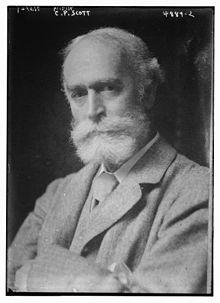
C P Scott (1846-1932)
Charles Prestwich (‘C.P.’) Scott, the legendary editor/owner of the Manchester Guardian, not only preached his Liberal politics in his newspaper, but also, for a decade, in the House of Commons.
Scott became editor of the paper in 1872 at the tender age of 25 – his cousin, J E Taylor, was its proprietor – and held the position for 57 years. Through his paper, he gradually achieved a national reputation at a time when the print press was the main source of parliamentary news and political opinion.
By the 1880s, Scott was contemplating running for Parliament, but initially received no encouragement from Taylor. However, by 1886, when Gladstone’s conversion to Irish Home Rule split the Liberal Party, it was Taylor, conscious perhaps of the commercial benefits of having his editor in the House, who suggested to Scott that he run for election.
Scott, already influential in Manchester Liberal politics, agreed to stand for the Manchester North East seat at the 1886 general election. He campaigned as a radical-minded Liberal, the stance he had developed for his paper, supportive of social and political reforms at a time when working-class issues were becoming more salient in national politics. He attacked the House of Lords for blocking the will of the more democratic Commons, and supported both fairer taxation and the payment of MPs.
Though Scott was unsuccessful at the 2 July poll, he slashed the Tory majority, with his 3,353 votes only 327 short of victory. He then effectively withdrew from the constituency for a few years, but was pushed back into the fray when the ministerial appointment of the sitting Tory triggered a by-election in October 1891, mere months before the expected general election.
His second campaign was fought on the same principles as before, but ran into difficulties over Irish policy. One lighter campaign moment came when Scott and his Tory opponent attended an FA Cup tie involving Newton Heath (the predecessor of Manchester Utd) on 3 October. At the polls, Scott again cut into the Tory majority, but lost narrowly.
The leading Liberal, James Bryce, tried to commiserate: “you will find the direction of the best organ of Liberalism more interesting than a session in a languid and expiring House would have been”. However, the by-election had established Scott more firmly on the national stage, and another colleague advised him that “you are now in the political stream and you must go on.” Scott became increasingly active in Manchester Liberal politics.
Scott made one final attempt at the Manchester North East seat in the 1892 general election, but with the same result, virtually replicating the 1891 by-election’s polling figures. It was clear to him that he would have to pursue his parliamentary ambitions elsewhere.
He finally succeeded in entering Parliament at the 1895 general election, very narrowly winning the Lancashire seat of Leigh, with a majority of 677 votes out of over 9,500.
Despite his skills as a newspaper editor, Scott was not ideally suited to Parliament. He had to divide his time between his parliamentary and newspaper work, and his wife’s deteriorating health also made heavy demands on him. Nevertheless, he did use his parliamentary platform to pursue his particular brand of Liberalism, speaking on social and economic issues, especially education.
His main focus was on Imperial affairs, including, in his first Parliament, the Sudan wars. But it was his opposition, both in the House and in the pages of the Guardian, to the controversial Second Boer War between 1899 and 1902 that really marked his parliamentary career. The War was politically divisive, especially within the Liberal Party, torn between its ‘imperialist’ and ‘pro-Boer’ wings. Scott wasn’t concerned just with grand imperial aspects of the War, but also with the suffering of civilians interned in concentration camps.
The War dominated the 1900 general election, overshadowing Scott’s local campaign in Leigh, even though he tried to broaden it to a more general opposition to Government policies. He was denounced as unpatriotic for taking the Boers’ side over the British soldiers and settlers in South Africa. Nevertheless, he scraped home with a majority of only 120.
Growing family and business pressures convinced Scott that he should stand down. In 1903 he said that he would not contest the next election, though he stayed until the end of the Parliament to avoid a by-election. His wife died in November 1905, and the previous month, the Guardian’s proprietor had died, which led to Scott becoming both editor and owner.
Ironically Scott gave up Parliament on the eve of the Liberals’ greatest triumph, at the 1906 election. He continued as a force in Liberal and national politics, but from his post at the Guardian rather than from a seat in the House.