
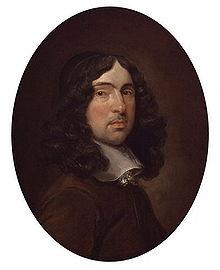
Andrew Marvell (1621-1678)
One of the 17th century’s greatest poets, Andrew Marvell also was a civil servant, and, for most of his last twenty years, an MP for his boyhood home of Kingston upon Hull.
He was first elected on 10 January 1659 to Richard Cromwell’s Parliament, when he and John Ramsden, an influential local merchant, won the two Hull seats against three other candidates, including Sir Henry Vane, who had represented Hull in the Long Parliament. However, this Parliament was short-lived, being dissolved on Richard Cromwell’s fall that spring, and replaced by the revived 1653 Rump Parliament, with Vane as Hull’s sole MP.
Marvell returned to Parliament the following year in the Convention Parliament which restored the monarchy. With 141 votes, he came second to Ramsden (227 votes), both comfortably beating four other candidates on 2 April 1660. His third and final election was on 1 April 1661, when he came second (with 240 votes), this time to Anthony Gilby (294), with two other candidates, including Ramsden, well beaten. He remained in this Cavalier Parliament almost all of its long duration, until his death in 1678.
During the short Convention Parliament, Marvell was appointed to 12 committees. When, on 17 December 1660, the House ordered the release of John Milton from the Serjeant at Arms’ custody, Marvell complained of the fees of £150 extracted by the Serjeant from his friend, and, after some heated debate, the matter was referred to the Committee of Privileges.
Though a fairly active MP, both on local and national issues, he was twice absent from Westminster for long periods. He went on a secret diplomatic mission to Holland in spring 1662. His absence was so prolonged that there were moves in Hull to replace him as Member, forcing him to return poste haste to the House on 2 April 1663. Yet, only a few months later, he was abroad again, acting as secretary to Lord Carlisle, Ambassador to Russia and Scandinavia, not returning until early 1665.
Marvell was proud of what he could do for his constituents in Parliament, more often more in committee and in legislation than through speeches. After prorogation in November 1675, he sought instructions from the Hull corporation: “I desire that you will consider whether there be anything that particularly relates to the state of your town … and I shall strive to promote it to the best of my duty”
He also wrote regularly to the corporation, almost 300 letters in total, from November 1660 until just before his death. Though usually dry and impersonal, they were an important source of information about Westminster at this critical period. For example, his 26 October 1667 letter related to the downfall of Charles II’s unpopular Lord Chancellor (and de facto Premier), Clarendon, an event in which Marvell played some part, especially as a member of the committee set up that October to investigate the government’s conduct of the recent Dutch War. In the ensuing debate on the 29th over Clarendon’s possible swift impeachment, Marvell warned against the need for such a step, “Lord Clarendon not being likely to ride away post.”
In return, the corporation paid Marvel a wage for his parliamentary service, at 6/8d (around 33p) per sitting day. For example, its cash book for 18 October 1675 notes payment to Marvell and Gilby “for 59 days each of them appeared for the Town in Parliament last session at 6shs 8d per day – each man’s part is £19 13shs 84d.” He also received expenses and occasional barrels of ale. For the latter, Marvell regularly thanked his constituents, though ”the quantity is so great that it might make sober men forgetful”. It is often claimed, inaccurately, that Marvell was the last MP until modern times to be paid.
On two occasions Marvell indulged in unparliamentary behaviour. In 1662 he was involved in a scuffle with Thomas Clifford, as the Journal of 18 March noted: “Ordered that the difference between Mr Marvell and Mr Clifford … be referred to Mr Speaker to examine… and to mediate and reconcile the same between them if he can…” Two days later, the Speaker found that Marvell “had given the first provocation that begot the difference: and that [he] should declare his sorrow for being the first occasion of the difference..” Marvell initially refused to apologise, but did so after the House made both Members suffer a severe rebuke from the Speaker.
Fifteen years later, Marvell was unhappy at the Speaker’s apparent mockery of one of his speeches. The following day, 29 March 1677, Marvell stumbled over the foot of another Member, Sir Philip Harcourt, and on recovering himself, gave Harcourt a playful box on the ear. The Speaker reported this ‘assault’ to the House, and Marvell, rather than apologising, referred back to the Speaker’s criticism of him the previous day, suggesting that, “as the Speaker keeps us in Order, he will keep himself in Order for the future.” This provoked a lengthy debate in the House, which only finally ended when Marvell eventually apologised.
Marvell will mainly be remembered for his poetry, but he lived at a time when satirical poetry and prose were political weapons which he, Milton and others regularly deployed, even if often, for obvious reasons, anonymously. He could also indulge in self-parody, as in this 1667 description of “the portly burgess, through the Weather hot / Does for his Corporation sweat and trot.” An apt description of Marvell, the conscientious constituency MP.