
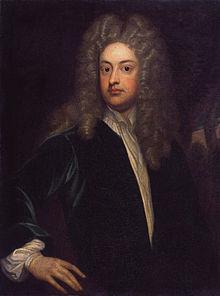
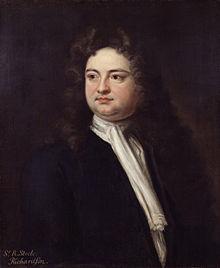
Joseph Addison (1672-1719) & Richard Steele (1672-1729)
The early 18th century was a literary golden age. Alongside Swift, Pope and Defoe, two luminaries whose names are invariably linked, were Joseph Addison and Richard Steele. As well as running and writing famous journals including The Spectator and The Tatler, they were Whig MPs.
The pair first met as schoolboys at Charterhouse. Thereafter both benefited from the social and political patronage of those days, as their separate literary reputations flourished. Both also became members of the influential Whiggish Kit-Cat Club.
Despite a Tory background, Addison was sympathetic to the Whigs and the ‘Glorious Revolution’. He wrote much-admired poems praising King William, which helped win him posts with various grandees, such as being Chief Secretary to the Lord Lieutenant for Ireland in 1709. While in Ireland, he was elected to the Irish House of Commons as a Member for Cavan Borough, holding the seat until 1713.
Addison’s entry into the Westminster Parliament was rather unusual. Through the patronage of Lord Sunderland, he replaced one of the Lostwithiel candidates at the 1708 general election on polling day itself, and was duly declared elected. The other successful candidate, Kendall, died shortly after, and the defeated candidates petitioned that the return of both Members was tainted by partiality. Eventually, in December 1709, a Commons committee decided in favour of the challengers, unseating both Addison and the late Kendall.
Fortunately, patronage again found him another seat, and he was returned unopposed at a by-election in Malmesbury in March 1710.
Steele expressed little interest in becoming an MP until after the zenith of the Addison-Steele journalistic period, including The Spectator (which had no direct connection with the modern political weekly). Though professing to be non-partisan, he had written, when launching The Guardian, that, when dealing with the parties, “I shall be impartial though I cannot be neuter.” He stood at Stockbridge in 1713, and won one of its two seats in a four-sided contest.
Unlike Addison’s silent Commons career, Steele launched straight into its proceedings, making his maiden speech on the new Parliament’s first day, in praise of the newly-elected Speaker. However, an unfortunate choice of words was taken as sexual innuendo by Tories who began laughing and shouting, “The Tatler! The Tatler!” He had to be pulled down by his sleeves by embarrassed fellow Whigs.
The Tories, then in power, wanted revenge for his biting literary attacks on them, and for his “scandalous” and “seditious” discussion of the royal succession. His defeated Tory opponents at Stockbridge duly presented a petition against the result on grounds of bribery, and there were suggestions that Steele still held a disqualifying office.
However, all that was overtaken by the Ministry’s censure motion against him in March 1714 for his seditious writings. Despite support from Whigs such as Walpole, Steele was found guilty and expelled. He immediately wrote to the Speaker asking either for leniency or a trial in the courts, but these pleas were rejected as “all debate upon that subject is closed and at an end.”
However, the accession of George I later that year revived both the Whigs and Steele’s prospects. He was knighted and found a new parliamentary seat, at Boroughbridge, at the 1715 general election.
Though Steele was the more active parliamentarian, Addison ultimately, if at the twilight of his career, attained the higher office, when in 1717, he was made a Secretary of State. However, he was an ineffective minister, due to ill-health and poor political skills, and soon fell victim to a rival Whig faction.
Unfortunately the pair’s long friendship ended badly, in a political dispute shortly before Addison’s death in 1719, over the government’s peerage bill. Steele strongly opposed the measure, but Addison, virtually in retirement, publicly supported it. The argument between them grew increasingly personal and bitter.
In Parliament, Steele campaigned on issues like the disastrous ‘South Sea Bubble’ in 1720. Shifting Whig factions necessitated a further change of constituency, from Boroughbridge to Wendover in 1722, where he won a seat by 71 votes. Shortly thereafter, he virtually retired from the Commons, though holding his seat until the end of the Parliament in 1727.
Addison and Steele should be remembered, not just as writers, but also as influential political figures of their age.