
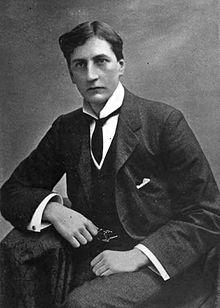
A E W Mason (1865-1948)
Alfred Edward Woodley (A E W) Mason was a prolific and popular author of the early 20th century, whose most famous (and often filmed) work was the 1902 imperial adventure story, The Four Feathers. For four years, from 1906, when in his early 40s, he also sat in the House of Commons as a Liberal MP for Coventry.
Following the great success of The Four Feathers, Mason’s writing was on the decline, and a move into the political arena seemed an opportunity to reinvigorate his creativity. On 24 November 1903, following a wide-ranging speech, he accepted what The Times described as a “hearty invitation” from the Liberals in Coventry to become their parliamentary candidate, and was formally adopted a week later.
The playwright, J M Barrie (of Peter Pan fame), followed Mason’s nursing of the constituency over the next two years, and at the 1906 election wrote: “He is loved all over the place and gets wound up at big meetings to great effect… He is as big a swell as ever, but his socks don’t match, and so all is well.”
Mason’s gain of Coventry was part of the 1906 Liberal landslide. At the poll on 16 January he took 6,554 votes to the 5,462 of his Conservative opponent, J Kenneth Foster. When the result was announced, Mason tried to thank his ecstatic supporters, but got not further than “My constituents..” before being drowned out by cheering. Barrie used this briefest of speeches at the end of Act 2 of his 1908 play, What every woman knows.
Mason was exhausted by the electioneering, and immediately took off for Switzerland to recuperate, in advance of the new Parliament meeting in mid-February.
His maiden speech was on 5 April, while the House was in Committee (though one biographer claims that honour for a later speech, on 15 November, during a debate on the controversial issue of the mistreatment of Chinese labourers in the Transvaal). It was a Supply debate on the expenses of the Colonial Office, in practice an attack on the Under-Secretary, Winston Churchill. Mason’s speech ranged across imperial policy and administration, vexed issues in the immediate aftermath of the divisive Boer War.
Mason made use of this parliamentary baptism in chapter 18 (‘A maiden speech’) of his 1912 novel, The Turnstile. He described his fictional alter ego, Captain Rames, faltering at the start, “in a voice which sounded to his ears weak and thin as a ghost’s. .. with a haze before his eyes and his hands clutching at the edges of his coat.” However, this phase suddenly passed, and he grew more confident. It was a full House: “curiosity, no doubt, had brought them in from the library and the smoking-room and the lobby when his name went up on the tape; he had, after all, a reputation.” It was, he concluded, “something of a small triumph.”
Mason’s parliamentary career was short, covering only the 1906 Parliament. During his four years in the House, he was a reasonably diligent Member, though not a prolific speaker. As he was but one of 400 Liberals, it was hard for him, as a novice, to stand out. He tended to concentrate on imperial matters, but also spoke on other controversial issues of the day, such as liquor licensing and the Finance Bill following Lloyd George’s famous 1909 Budget. He was also well liked within his Coventry constituency, and often spoke at civic meetings
Opinions differ as to his success as an MP. While some sympathetic commentators praised his public speaking, independence and influence, a more negative note was sounded by a contemporary MP of almost a half-century’s standing, Earl Winterton. He concluded that Mason, like his fellow novelist in that 1906 Parliament, Hilaire Belloc, failed to observe the golden rule that outside fame was not an automatic short-cut to respect within Westminster.
Perhaps Mason himself realised he was not cut out for a more permanent parliamentary career, especially if he wished to maintain his many and varied outside interests, not least his writing. Though urged to continue, and even promised some sort of ministerial post in the new Parliament, he declined to seek re-election at the first 1910 general election: “I can’t stand again – I’m three years behind on my contracts!”
It is fitting that the last word should go to a fellow novelist and Coventry MP. In moving the Loyal Address following the Queen’s Speech on 21 April 1966 (after Harold Wilson’s substantial general election victory the previous month), Maurice Edelman said:
“Among Coventry’s varied representatives—and I refer to him with a little diffidence—I must mention A. E. W. Mason, the novelist, who sat in the 1906 Parliament. He entered politics with enthusiasm—and left with alacrity. Parliament, he said, was too noisy and politics too fatiguing. So he joined an expedition to the South Pole.”